 © Ram Brij
The SCALE Framework
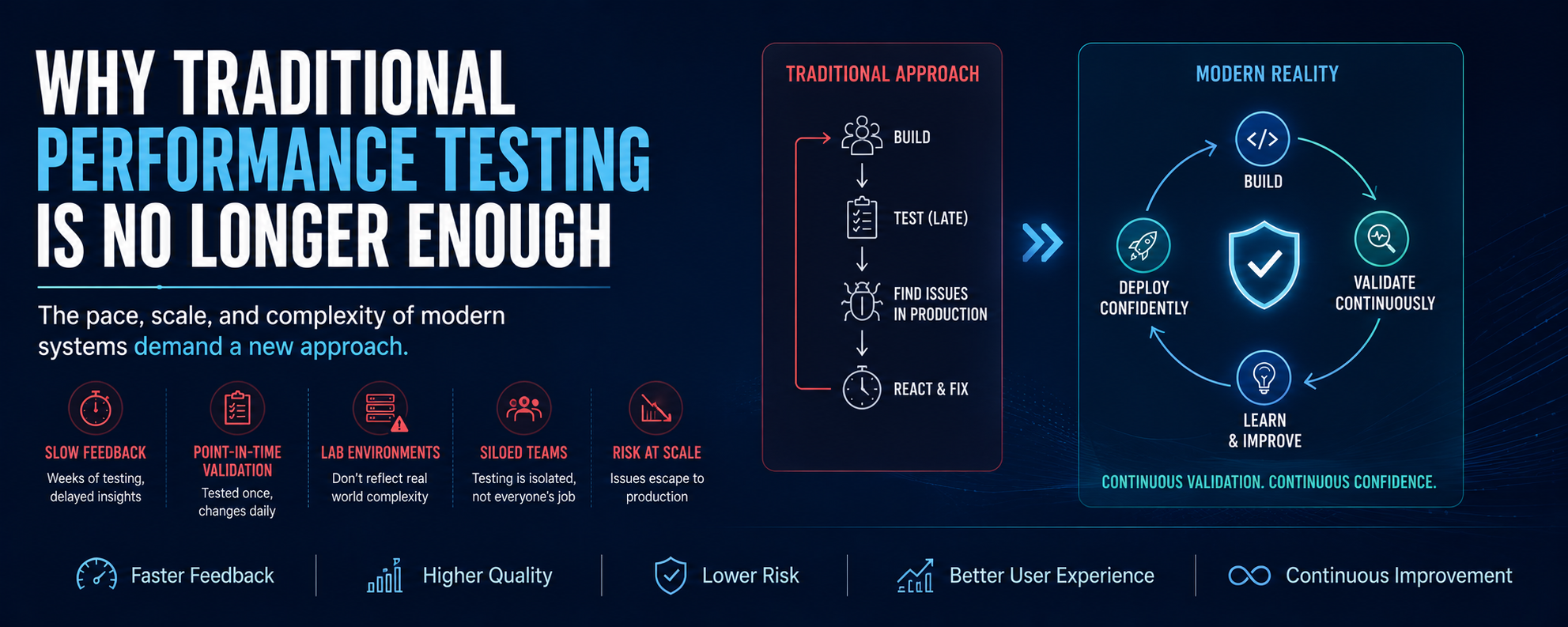
Why Traditional Performance Testing Is No Longer Enough
Performance testing tells us how software behaves under a known workload. Continuous Performance Engineering prepares software for everything we don't yet know.
~ Ram Brij
📘 About this Series
The SCALE Framework Series explores the SCALE Framework, an original methodology for Continuous Performance Engineering developed by Ram Brij through years of enterprise software engineering and technology leadership. Each article builds on the previous one, gradually introducing the framework's philosophy, principles, and practical implementation.
You're reading: Part 2 – Performance Testing Is No Longer Enough
We'll explore why many performance issues originate long before a load test is ever executed, and why modern software demands a broader engineering discipline.
Performance Testing Is No Longer Enough
Understanding the Difference Between Testing Software and Engineering Systems
When I first started working with enterprise applications, performance testing had a clear, respected place in the software delivery lifecycle. Teams planned for it carefully and invested real time preparing for it before every major release. Passing a performance test meant something: it told everyone the application could handle the expected load and meet its service targets. It was a real milestone, and for years, it served the industry well.
I want to be upfront about something: I don't think traditional performance testing is obsolete. I still think it's one of the most valuable disciplines in engineering.
The problem was never performance testing itself. The problem is assuming that performance testing, on its own, is enough to prepare modern software for production. Those two ideas sound like they contradict each other, but they don't, they just reflect how much software has changed underneath us.
The world performance testing was built for
To see why so many teams struggle today, it helps to remember the environment traditional performance testing grew up in.
Fifteen or twenty years ago, enterprise applications were fairly predictable. Most ran as large, self-contained systems on infrastructure that barely changed month to month. Releases came every few months, not every few hours. Architecture diagrams had fewer moving parts, dependencies were easy to trace, and the operating environment stayed stable for the life of a release.
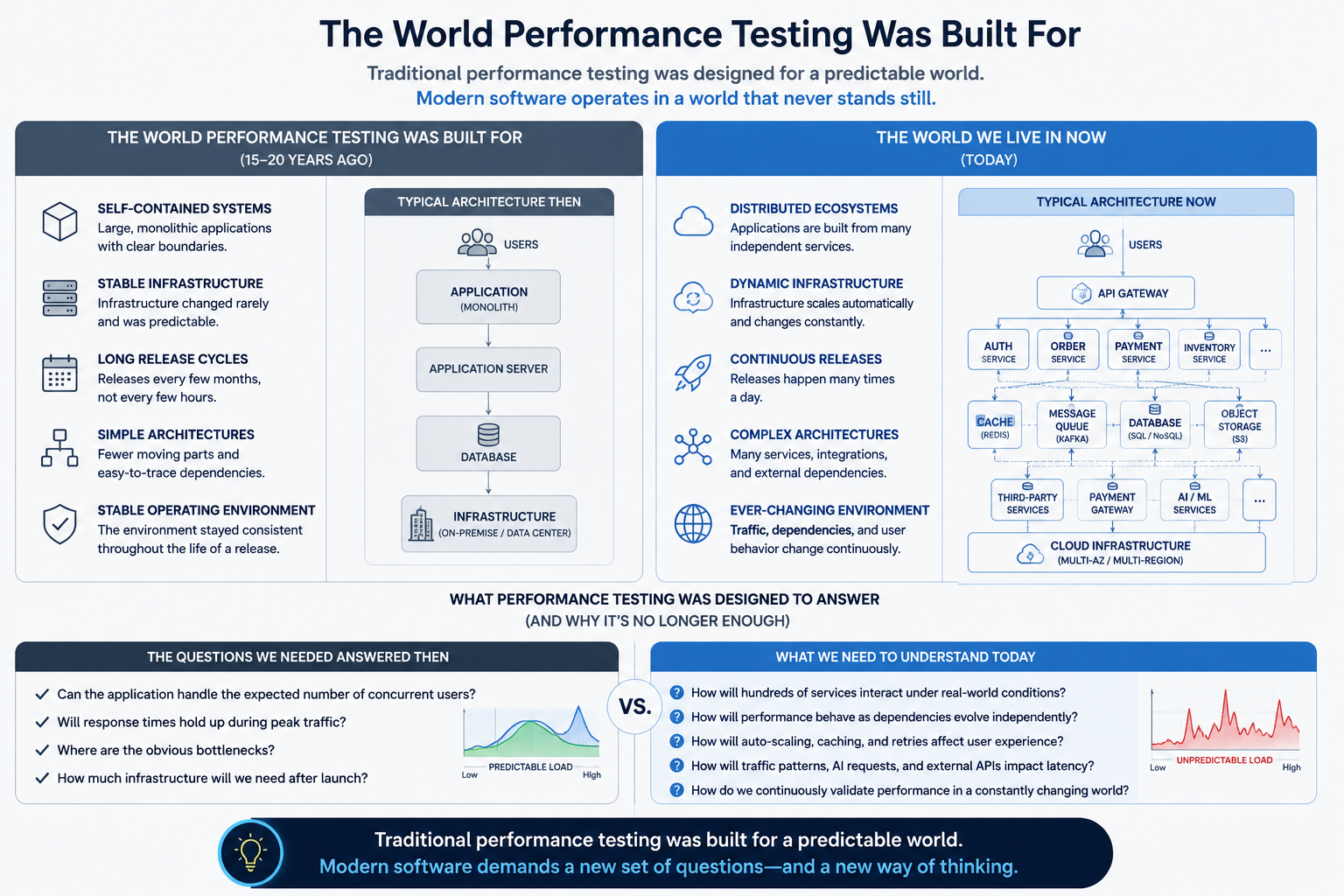
In that world, performance testing answered exactly the questions teams needed answered: could the app handle the expected number of concurrent users? Would response times hold up during peak traffic? Where were the obvious bottlenecks? How much infrastructure would we need after launch?
Those are still good questions. They just aren't sufficient anymore. Modern software raises a whole new set of questions that traditional performance testing was never built to answer.
Complexity isn't the real shift — constant change is
It's tempting to blame all of this on microservices. They're part of it, but they're not the whole story.
Today's applications live inside ecosystems that keep moving. A single button click might quietly touch an API gateway, an authentication provider, a fraud detection service, several microservices, event streams, distributed caches, a recommendation engine, a cloud-managed database, an observability platform, a few third-party APIs, and increasingly, an AI-powered decision service.
Every one of those pieces can change on its own schedule. One team ships a new service. Another team upgrades a database driver. A cloud provider quietly changes how its infrastructure behaves. A third-party API gets slower. Customer traffic patterns shift overnight. An AI model gets retrained on new data.
None of that requires your application to change. But all of it can change how your application behaves.
That's the real shift in modern software: it isn't static anymore, it's continuously evolving. And software that keeps evolving can't rely on a test that was only valid for the few hours before it shipped.
The assumption worth questioning
Most software delivery processes carry a quiet assumption: if the application passes its performance test before release, it's ready for production.
That sounds entirely reasonable, it's exactly what performance testing is supposed to give you: confidence. But confidence has a shelf life.
Say you run a thorough performance test on Monday. By Friday, several dependent services have been updated, infrastructure has autoscaled dozens of times, a marketing campaign has shifted traffic patterns, a feature flag has rolled out to a slice of customers, and a third-party provider is running a little slower than before.
Your code hasn't changed at all. But the environment it runs in has changed a lot. Monday's report is still technically accurate, it's just describing a world that doesn't exist anymore.
That's the uncomfortable truth a lot of engineering teams eventually run into: performance testing captures a snapshot. Production is a moving target.
Most performance problems start long before testing does
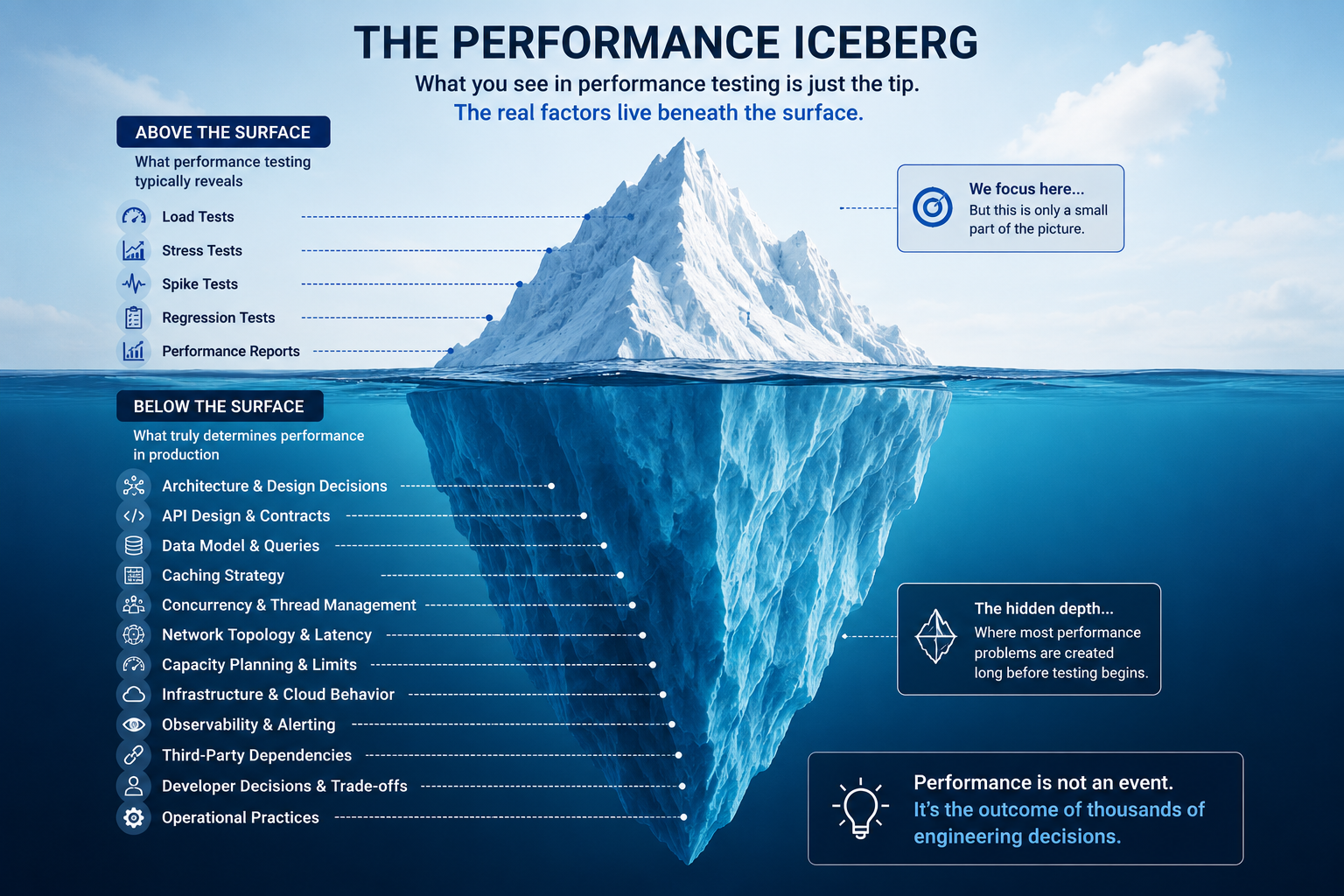
One of the most useful things I've learned is that performance rarely breaks down because someone skipped a load test. It usually breaks down because of engineering decisions made months earlier decisions that seemed completely reasonable at the time.
An API gets designed without any latency target because the initial workload looks small. A team picks synchronous communication because it's simpler to build, even though the system will need to go asynchronous eventually. Caching gets pushed to "later" because the first release isn't expected to see heavy traffic. Observability gets deprioritized because the team is heads-down on shipping features.
None of these choices looks like a mistake in isolation. Together, they quietly decide how the system will behave long before anyone sits down to design a performance test.
By the time testing starts, a lot of the architectural decisions that determine scalability are already locked in expensive or impossible to unwind. Performance testing can tell you the consequences. It can't redesign the architecture.
A different question
Somewhere along the way, I noticed my own thinking had shifted.
Early in my career, the question I kept asking was: how do we improve our performance testing? Eventually that turned into a different question entirely: how do we make better engineering decisions so performance problems don't show up in the first place?
That one shift changed almost every conversation I had with engineering teams afterward. Architecture discussions became performance discussions. API design became performance design. Observability stopped being an ops afterthought and became part of the architecture itself. Performance stopped being one specialist team's job and became something the whole engineering org owned.
Looking back, that wasn't the moment the SCALE Framework was born. But it was the moment I understood why it needed to exist.
Beyond testing
None of this means performance testing should go away. Keep investing in load testing, stress testing, endurance testing, capacity planning all of it still matters.
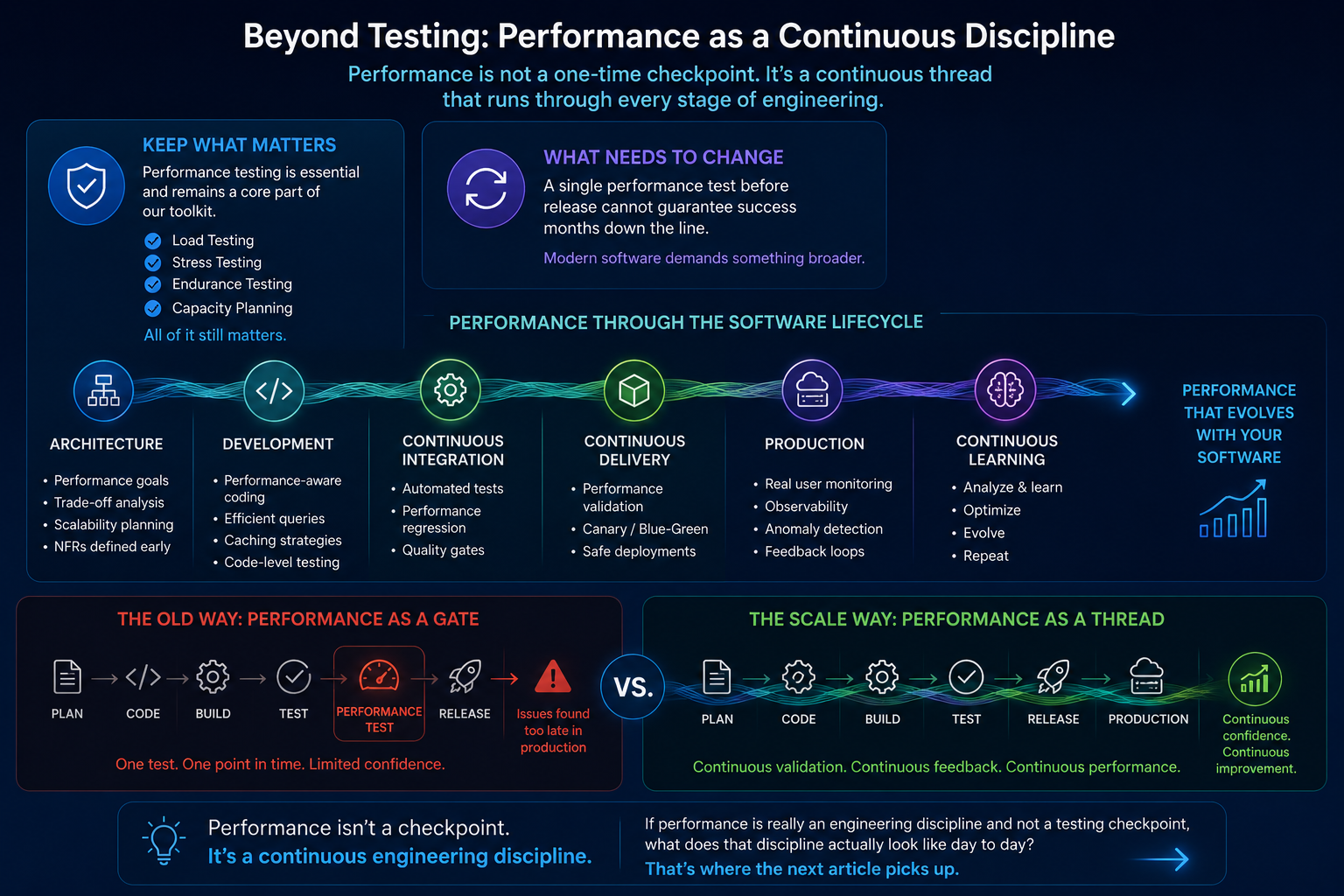
What has to change is the expectation that a performance test, run once before release, is enough to guarantee success months down the line. Modern software needs something broader: an engineering discipline that starts at the architecture stage, runs through development, plugs into continuous delivery, keeps learning from production, and evolves alongside the software itself.
Performance shouldn't be a gate at the end of the pipeline. It should be a thread that runs through every stage of engineering.
That's the idea the SCALE Framework grew out of. Before we get into its five principles, there's one more question worth sitting with: if performance is really an engineering discipline and not a testing checkpoint, what does that discipline actually look like day to day?
That's where the next article picks up.
SCALE Insight
Traditional performance testing remains essential but it validates software at a moment in time. Modern engineering teams need something broader: a continuous approach that begins with architecture, learns from production, and evolves with every change. That is the shift from Performance Testing to Continuous Performance Engineering.
Next in the SCALE Framework Series
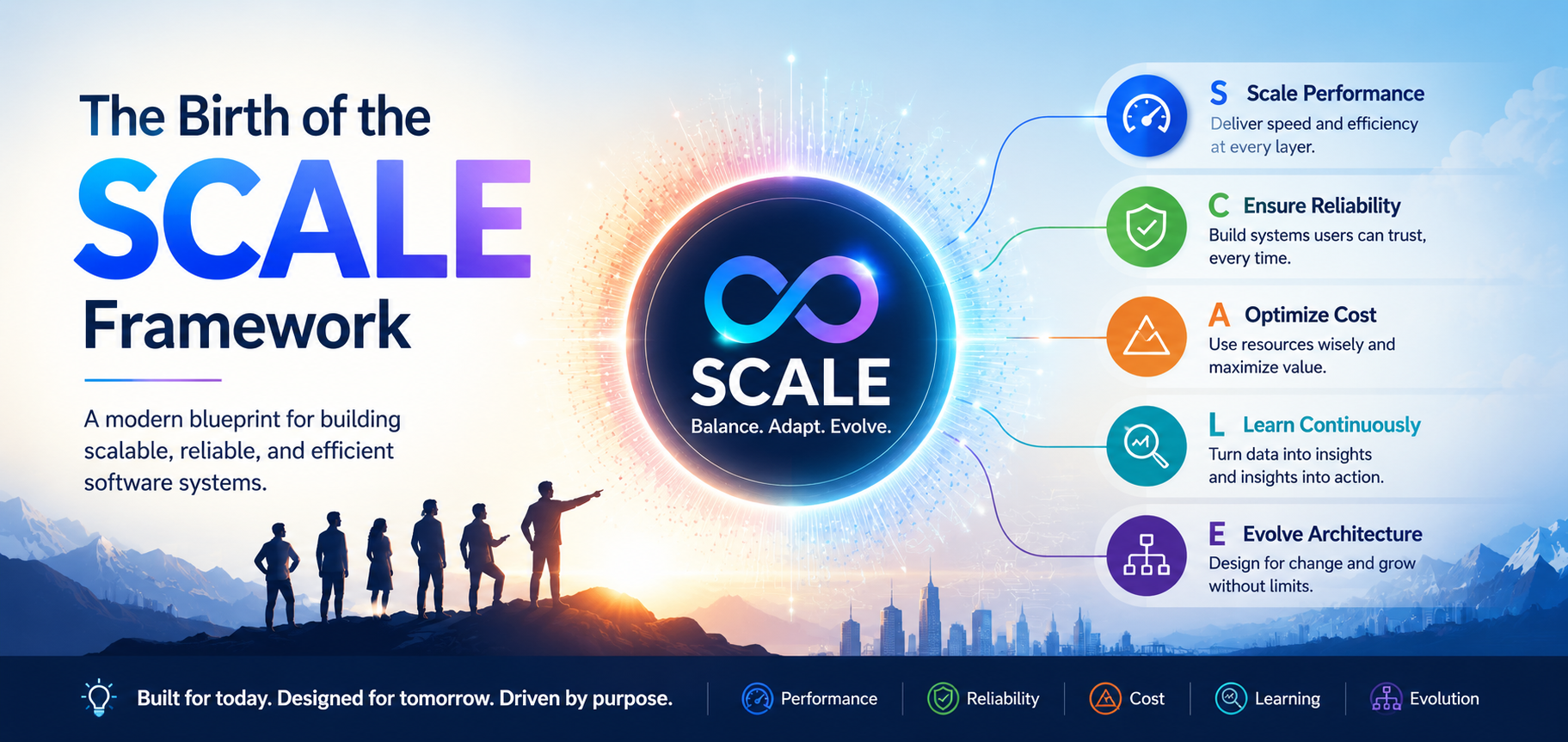
Article 3 – The Birth of the SCALE Framework: Five Principles for Continuous Performance Engineering
Previous read
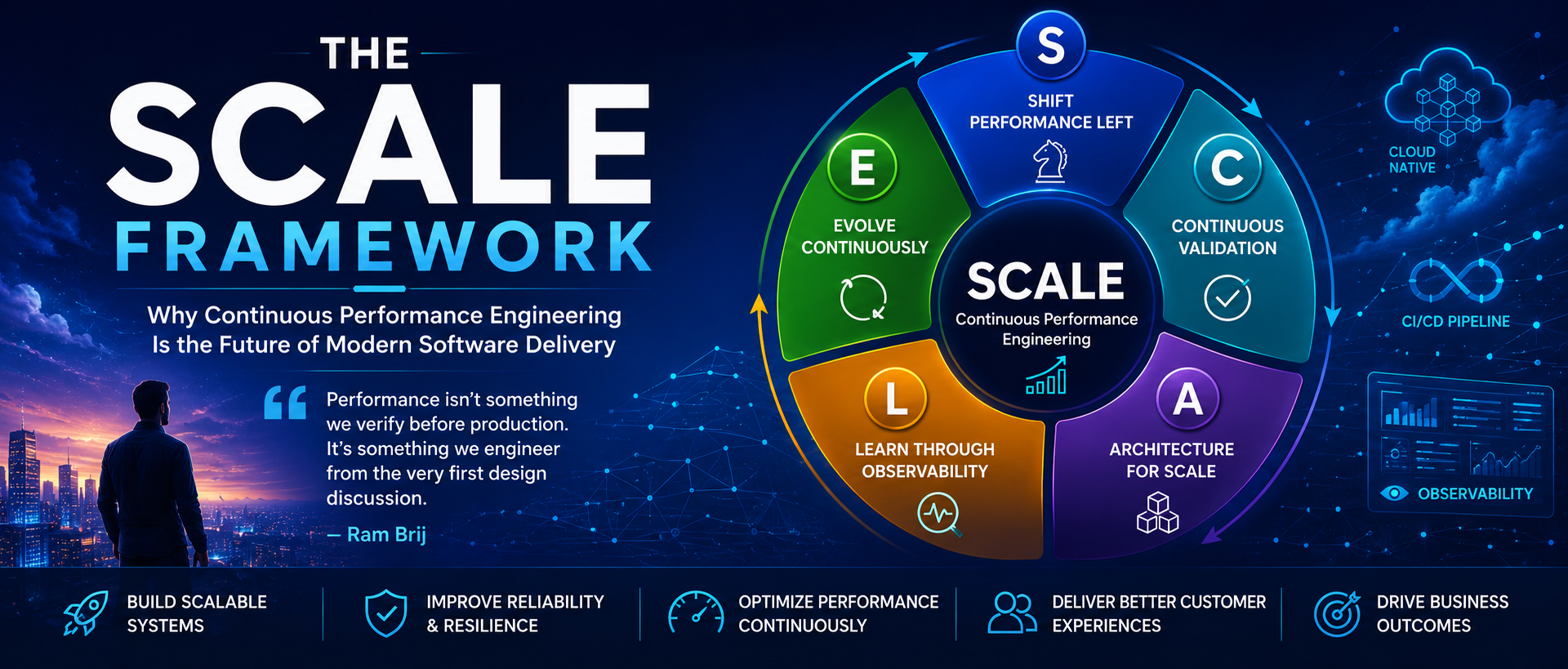
The SCALE Framework
Why Continuous Performance Engineering Is the Future of Modern Software Delivery
Suggested next read
The SCALE Framework
The Birth of the SCALE Framework
Comments (0)
No comments yet. Be the first!