 © Ram Brij
The SCALE Framework
Shift Performance Left: Why the Most Important Performance Decisions Are Made Before the First Line of Code
📘 About this Series
The SCALE Framework Series explores the SCALE Framework, an original methodology for Continuous Performance Engineering developed by Ram Brij through years of enterprise software engineering and technology leadership. Each article builds on the previous one, gradually introducing the framework's philosophy, principles, and practical implementation.
You're reading: Part 4 – Shift Performance Left: Why the Most Important Performance Decisions Are Made Before the First Line of Code
The cheapest performance problem you'll ever solve is the one you prevent during design.
~ Ram Brij
Shift Performance Left
Why the Most Important Performance Decisions Are Made Before the First Line of Code
Ask ten engineers where performance engineering begins, and you'll probably hear the same answer: "During performance testing."
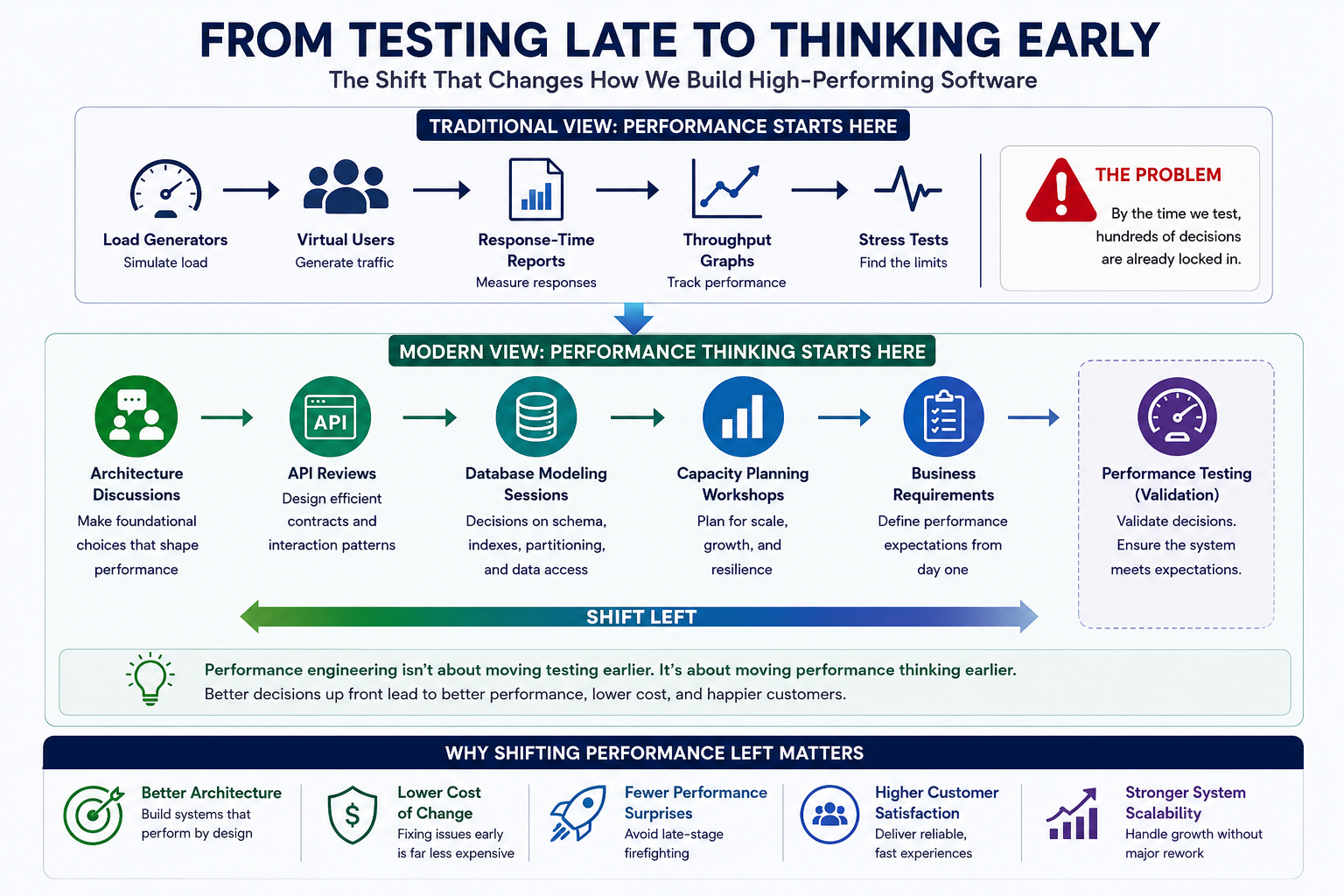
It's an understandable response. For decades, performance has been associated with load generators, virtual users, response-time reports, throughput graphs, and stress tests. Entire engineering disciplines have evolved around measuring how software behaves under increasing demand. Those practices remain essential, and I would never suggest that organizations reduce their investment in them.
What has changed isn't the importance of performance testing. What has changed is the world in which our software operates.
After years of designing enterprise payment platforms, secure authentication systems, cloud-native services, and distributed architectures, I've come to believe that performance engineering begins long before anyone opens a performance testing tool. It begins during architecture discussions, API reviews, database modeling sessions, capacity planning workshops, and sometimes even during the earliest conversations about business requirements.
By the time a performance engineer executes the first load test, hundreds of engineering decisions have already been made. Those decisions will influence the system's long-term performance far more than any optimization applied a few weeks before production.
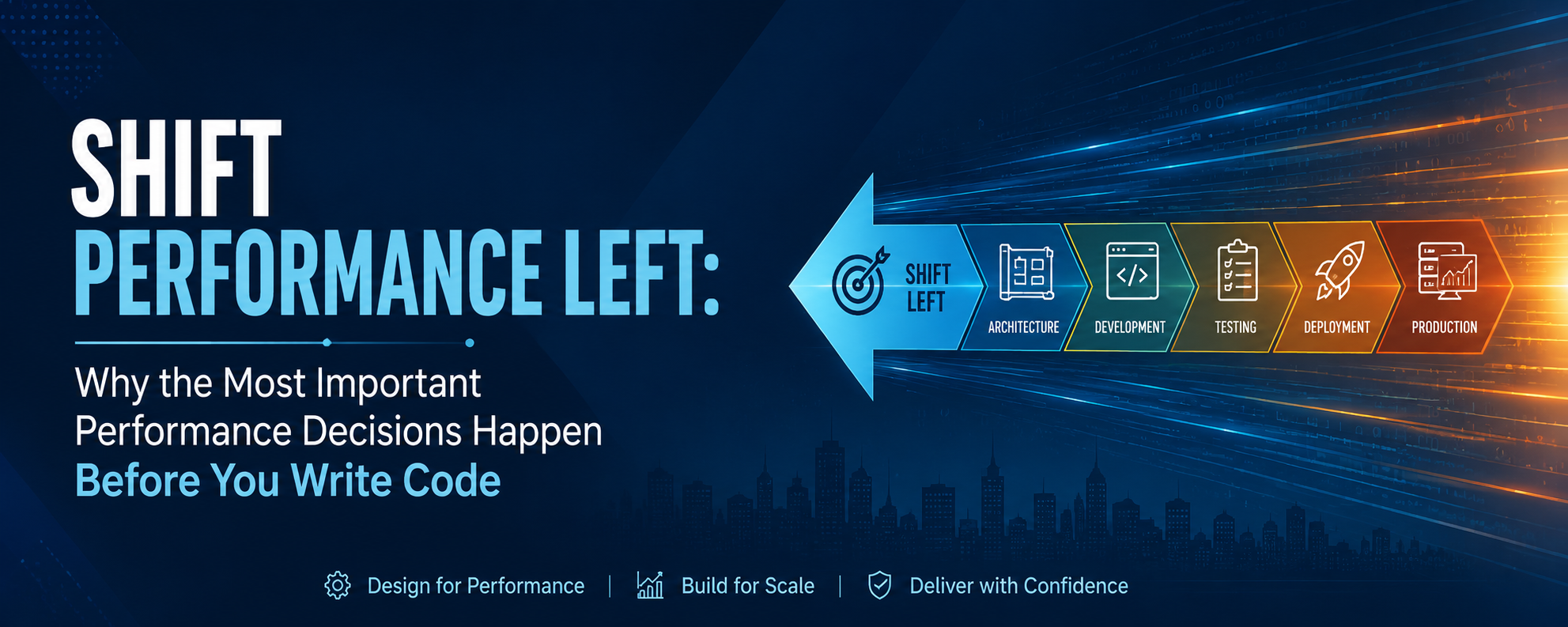
That realization eventually became the first principle of the SCALE Framework: Shift Performance Left.
Not by moving performance testing earlier in the delivery pipeline. By moving performance thinking earlier. That distinction fundamentally changes how engineering teams design software.
The Most Expensive Performance Bug Is Usually Invisible
Throughout my career, I've participated in countless production reviews where engineering teams worked tirelessly to improve performance shortly before a release. We optimized SQL queries, tuned JVM parameters, increased infrastructure capacity, adjusted thread pools, and occasionally rewrote entire services.
Those efforts absolutely improved the system. But looking back, many of them were treating symptoms rather than addressing the original cause.
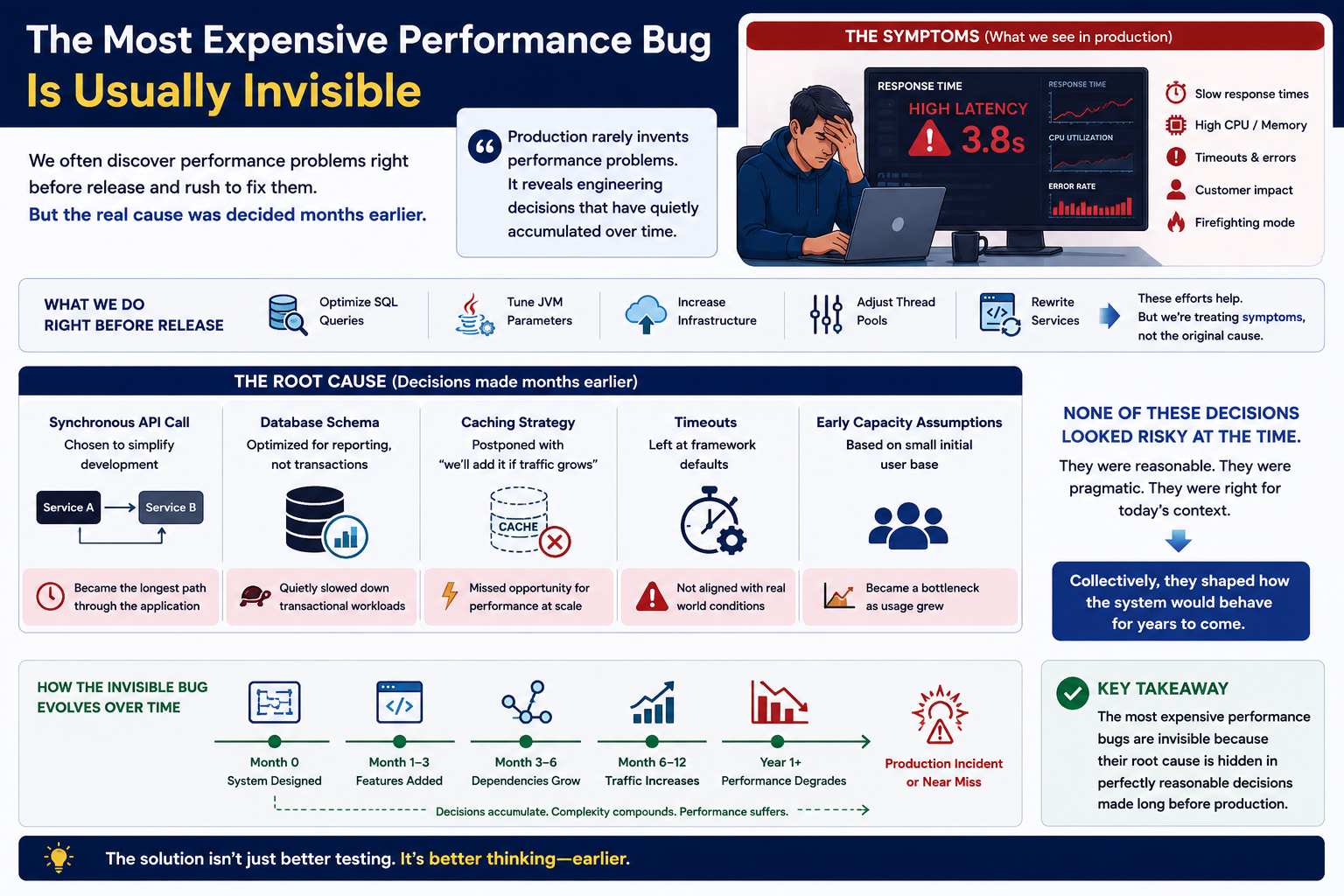
The root issue almost always traced back to a design decision made months earlier. A synchronous API call introduced because it simplified development gradually became the longest path through the application. A database schema optimized for reporting quietly slowed transactional workloads. A caching strategy was postponed because "we'll add it if traffic grows." Timeouts remained at framework defaults because the first release only supported a relatively small customer base.
None of those decisions appeared risky when they were made. In fact, most of them were perfectly reasonable based on the information available at the time. Collectively, however, they shaped how the system behaved years later.
One lesson I've learned repeatedly is that production rarely invents performance problems. More often, it reveals engineering decisions that have quietly accumulated over time.
An Enterprise Perspective
One experience that reinforced this way of thinking came during work on a high-throughput enterprise platform where every customer request depended on multiple downstream services completing within extremely tight response-time expectations.
The application passed its performance tests. Infrastructure looked healthy. Individual services appeared well optimized. Yet under sustained production traffic, overall response times gradually drifted beyond the team's expectations.
After several investigations, the conclusion wasn't that a particular component had failed. The architecture itself had simply evolved. Over time, additional service calls had been introduced, new business validations had been added, and dependencies had grown organically as the platform matured. None of those changes looked significant when viewed individually. Together, they had fundamentally changed the performance characteristics of the system.
Nobody had written inefficient code. Nobody had skipped performance testing. The architecture had simply moved beyond the assumptions it had originally been designed around.
That experience taught me something I still carry into every architecture review today: performance problems often emerge gradually. Performance thinking has to begin early enough to evolve alongside the system itself.
Architecture Is the First Performance Test
One of the most common misconceptions I encounter is the belief that architecture and performance are separate conversations. In reality, they are often the same conversation viewed from different perspectives.
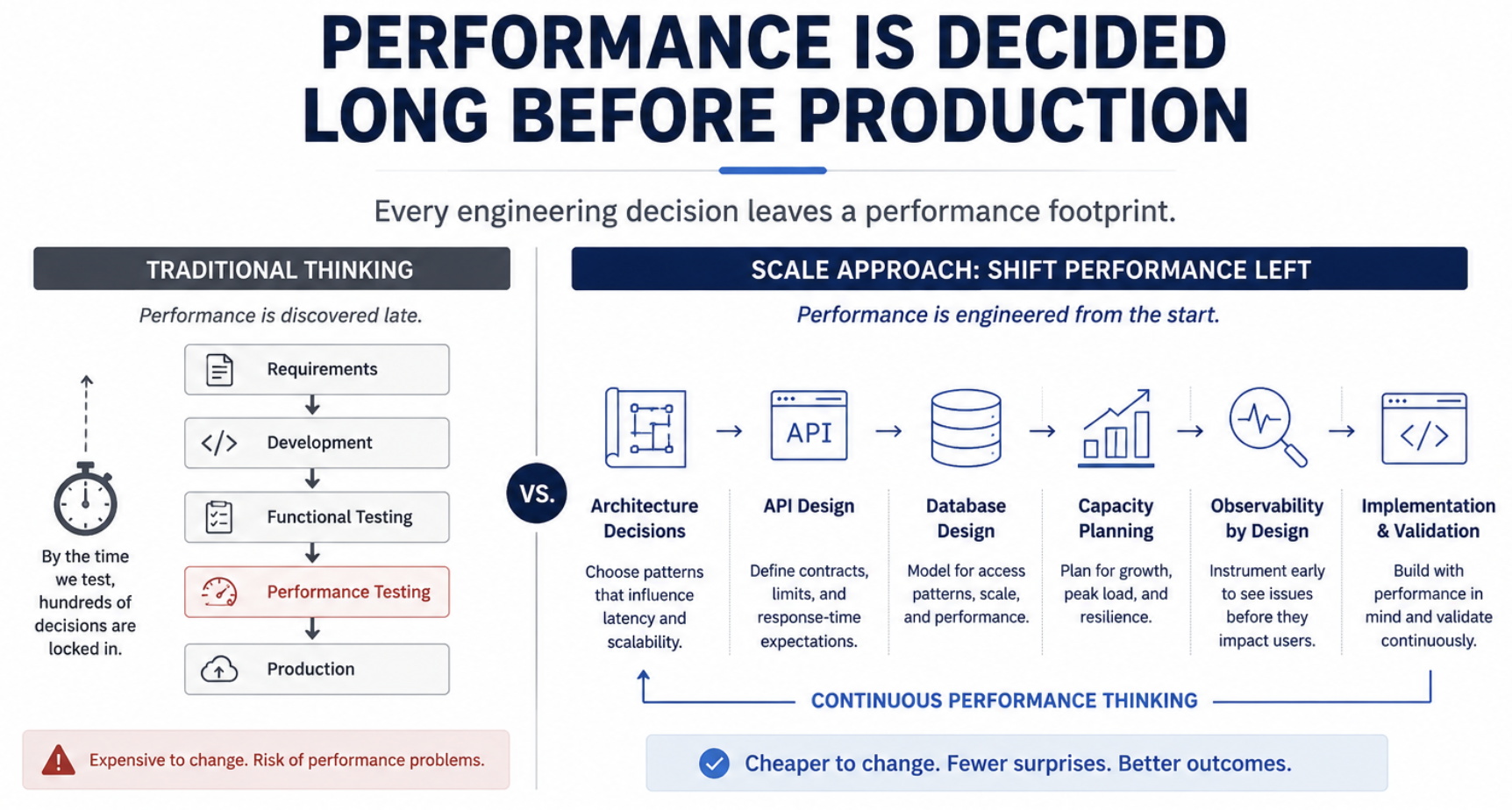
Choosing synchronous communication instead of asynchronous messaging is a latency decision. Centralizing a database is a scalability decision. Designing an API without response-time expectations is a performance decision. Delaying observability until after implementation is a troubleshooting decision made long before the first production incident occurs.
Performance isn't something we layer onto software after development. It's embedded in every architectural choice we make. In that sense, architecture is the first performance test every system takes.
Better Questions Lead to Better Systems
Shifting performance left doesn't mean predicting every future bottleneck. No engineering team can do that. Instead, it means asking better questions before implementation begins.
What response time should customers experience?
Where is latency most likely to accumulate?
Which services are likely to become future bottlenecks?
Should this workflow remain synchronous, or will asynchronous processing provide greater resilience?
How will the system behave if one dependency suddenly slows down?
Where will caching create the greatest value?
How much growth should this architecture realistically accommodate?
Which operational metrics will tell us whether our assumptions were correct?
What's interesting is that none of these questions require a performance testing tool. They're architecture questions.
Performance Is a Design Requirement
Functional requirements describe what software should do. Performance requirements describe how well it should do it. Unfortunately, performance expectations often remain surprisingly vague.
"The application should be fast." "The API should perform well." Statements like these provide very little engineering guidance.
Effective engineering organizations replace vague expectations with measurable objectives. For example:
95% of API requests complete within 200 milliseconds.
Payment authorization completes within one second.
The platform supports 50,000 concurrent users.
Database queries remain below 20 milliseconds.
Customer-facing pages load in under two seconds.
These aren't testing targets. They're architectural constraints that influence design long before implementation begins.
Every API Is a Performance Contract
APIs are often described as contracts between systems. That's true. What we discuss less often is that they're also contracts for performance.
Every request introduces latency. Every payload consumes bandwidth. Every dependency creates another opportunity for delay. Once an API becomes widely adopted across an organization, changing those characteristics becomes significantly more difficult.
That's why I encourage engineering teams to treat API design not only as an interface design exercise, but also as one of the earliest performance decisions they'll make.
Designing Latency Budgets
One practice I've found particularly valuable is thinking in terms of latency budgets. Suppose an API has a response-time objective of 300 milliseconds. That budget doesn't belong to one service. It belongs to the entire request.
Authentication may consume 40 milliseconds. Business logic another 120. Database operations 80. Network communication 30. Observability overhead 10.
Once teams begin thinking this way, conversations naturally change. Instead of asking, "Is the system fast enough?" they begin asking, "Is each component spending its share of the latency budget wisely?" That's a much more productive engineering discussion.
Designing for Tomorrow's Capacity
Capacity planning is often treated as something organizations revisit after growth begins. By then, many architectural decisions are already expensive to change.
Performance-aware architecture asks different questions much earlier. What happens if customer traffic doubles? What if one service suddenly experiences five times its expected load? How will a major product launch affect infrastructure? Where should horizontal scaling begin?
Designing for growth doesn't mean over-engineering. It means understanding where growth is most likely to occur and preparing accordingly.
Databases Remember Every Design Decision
One of the more persistent myths in software engineering is that databases suddenly become bottlenecks. Most don't. They gradually become bottlenecks because they were designed for today's workload instead of tomorrow's.
Schema design. Indexes. Partitioning strategies. Transaction boundaries. Read-versus-write optimization. These are architectural decisions made long before any performance test is executed. Performance testing simply reveals the consequences.
Choosing Events Over Waiting
It would be easy to conclude that every modern system should be event-driven. I don't believe that's true. I've also seen organizations introduce asynchronous processing long before the business actually needed it, adding operational complexity without delivering meaningful value.
Every architectural decision introduces trade-offs. Event-driven systems improve scalability and resilience. They also increase complexity, make debugging more challenging, and place much greater importance on observability.
Shifting performance left isn't about choosing one architectural pattern over another. It's about having those trade-off discussions before implementation begins not after production traffic forces them upon you.
Why Waiting Is the Most Expensive Optimization Strategy
The greatest benefit of shifting performance left isn't simply faster response times. It's reducing the cost of change.
Architectural improvements are relatively inexpensive during design. They become significantly more expensive during implementation. After deployment, they become exponentially more difficult.
Performance engineering isn't only about building faster software. It's about making better engineering decisions while those decisions are still inexpensive to change.
SCALE Insight
Performance isn't created by load tests. It's created by architecture, engineering decisions, and thoughtful trade-offs made long before software reaches production. Shifting performance left isn't about moving testing earlier. It's about making performance part of every engineering conversation from the very beginning.
Next in the SCALE Framework Series
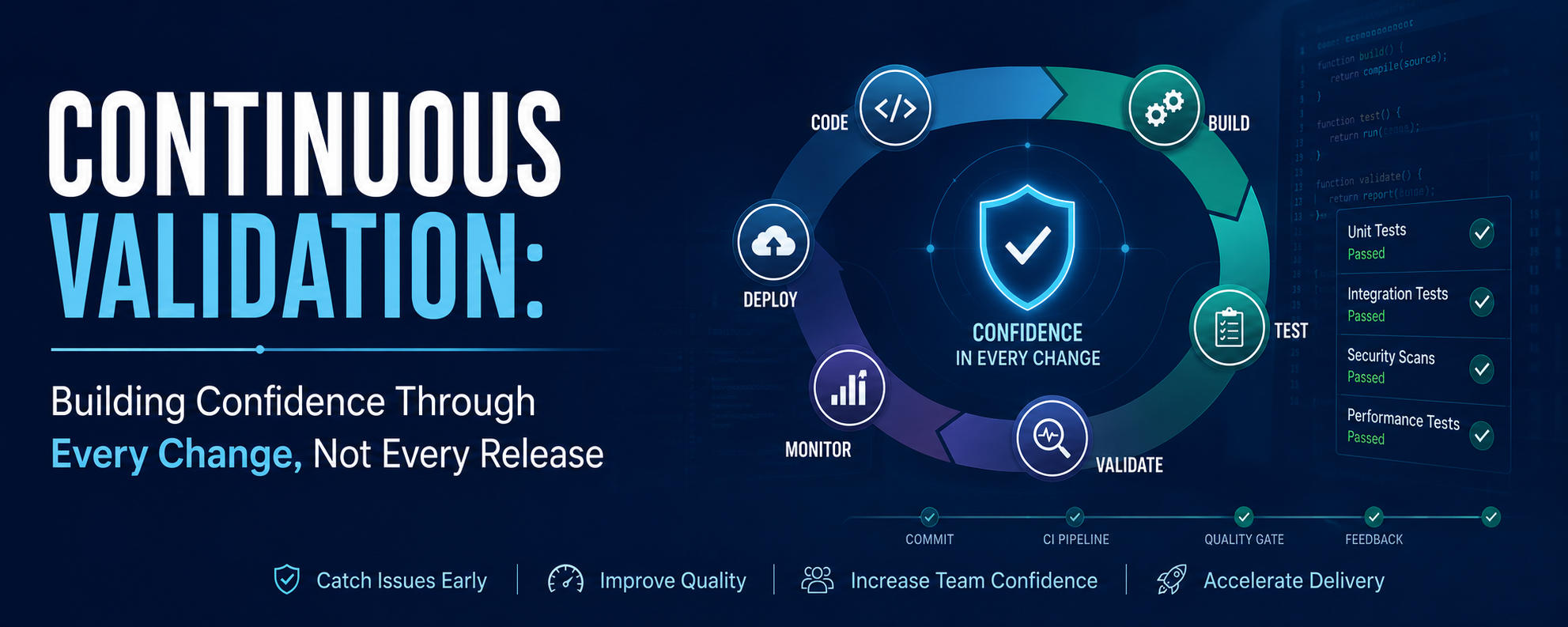
Article 5 – Continuous Validation: Building Confidence Through Every Change, Not Every Release
Previous read
The SCALE Framework
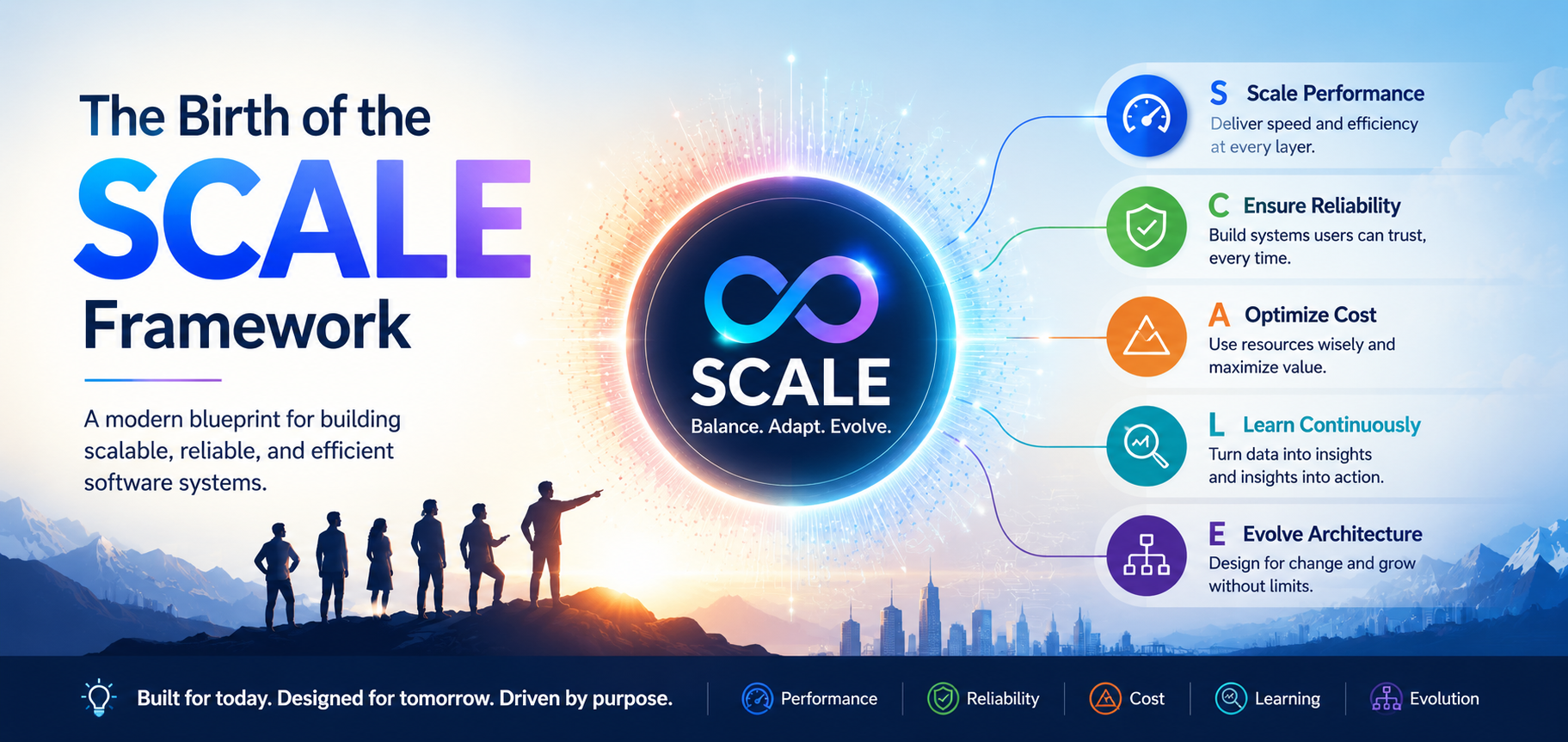
The Birth of the SCALE Framework
Suggested next read
The SCALE Framework
Continuous Validation: Building Confidence Through Every Change, Not Every Release
Comments (0)
No comments yet. Be the first!