 © Ram Brij
The SCALE Framework
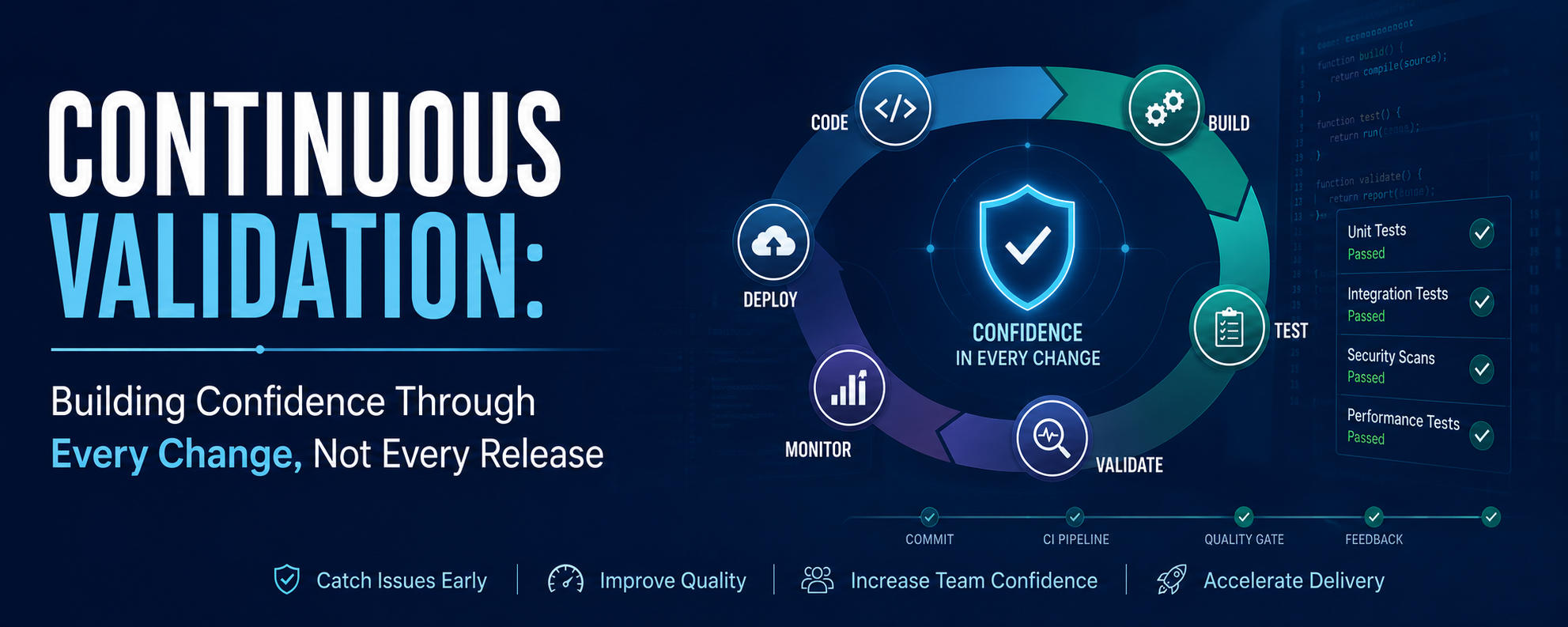
Continuous Validation: Building Confidence Through Every Change, Not Every Release
📘 About this Series
The SCALE Framework Series explores the SCALE Framework, an original methodology for Continuous Performance Engineering developed by Ram Brij through years of enterprise software engineering and technology leadership. Each article builds on the previous one, gradually introducing the framework's philosophy, principles, and practical implementation.
You're reading: Part 5 – Continuous Validation: Building Confidence Through Every Change, Not Every Release
Continuous Validation
Building Confidence Through Every Change, Not Every Release
The software industry has become remarkably good at delivering change. Modern engineering teams deploy dozens, sometimes hundreds, of times a day. Infrastructure scales itself automatically. Feature flags turn on functionality without a deployment at all. Cloud providers keep improving the managed services underneath us. AI models evolve independently of our own release cycles. Third-party APIs change without so much as a heads-up.
Here's the irony: our ability to deliver software has sped up dramatically, but our idea of what "engineering confidence" means hasn't kept pace.
Most organizations still measure confidence the way they did twenty years ago. Run the regression suite, run the performance test, complete the security scan, get stakeholder sign-off, call it ready for production. Validation sits near the end of delivery — a final checkpoint you clear before deploying.
That approach made perfect sense when software changed slowly. It gets a lot shakier the faster software changes.
One of the most overlooked things about modern software isn't its complexity, its scale, or even its distributed architecture. It's that confidence itself has become temporary. Every deployment shifts your engineering assumptions a little. Every infrastructure upgrade changes operational behavior. Every cloud platform update introduces new variables. Every feature flag changes the customer journey. Every AI model retraining subtly reshapes system behavior. Every third-party dependency keeps evolving on its own schedule.
None of that necessarily means something's broken. It just means yesterday's confidence is a little less relevant today.
That's the real challenge for modern engineering teams. The question isn't "did we validate the software before release?" anymore. It's "how do we continuously know the software is still behaving the way we expect?"
That shift changes what validation actually is. It stops being an event and becomes a discipline something you practice continuously, not something you check off once.
That's the second principle of the SCALE Framework: Continuous Validation. Not because testing matters less. Because confidence has gotten harder to hold onto.
Why one performance test is never enough
A performance test captures exactly one thing: how the system behaved, under one set of conditions, at one moment in time. That snapshot is useful, but production doesn't hold still long enough for a single snapshot to keep describing it.
Kubernetes reschedules pods and rebalances nodes on its own. Cloud providers roll out infrastructure changes underneath your application without asking. Customer traffic shifts with the news cycle, a marketing push, or just the time of day. Dependencies get upgraded on their own release schedule. AI components behave differently as the data feeding them changes.
Every one of those things can move the needle on performance, and none of them wait for your next scheduled test to happen. That's why confidence, measured once, doesn't hold steady, it decays. Think of it as a curve rather than a single point in time:
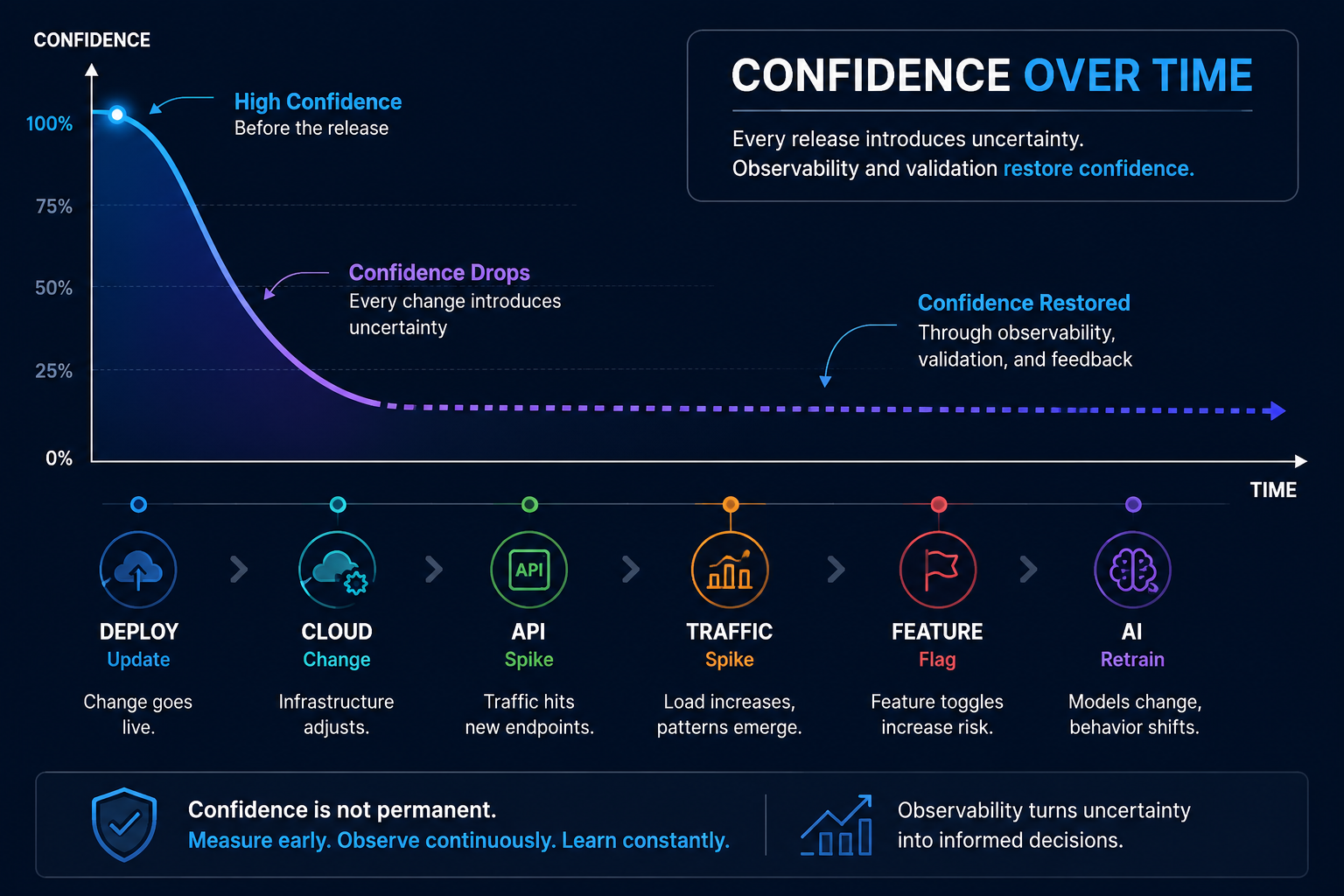
Each event along that timeline chips away a little more at how much you can trust last week's test results. Continuous Validation exists to flatten that curve — to keep re-earning confidence instead of spending down a balance that was never going to last.
Continuous validation throughout the software lifecycle
If validation only happens once, it's a gate. If it happens continuously, it becomes part of how the system works. In practice, that means weaving validation into every stage of the lifecycle rather than parking it at the end:
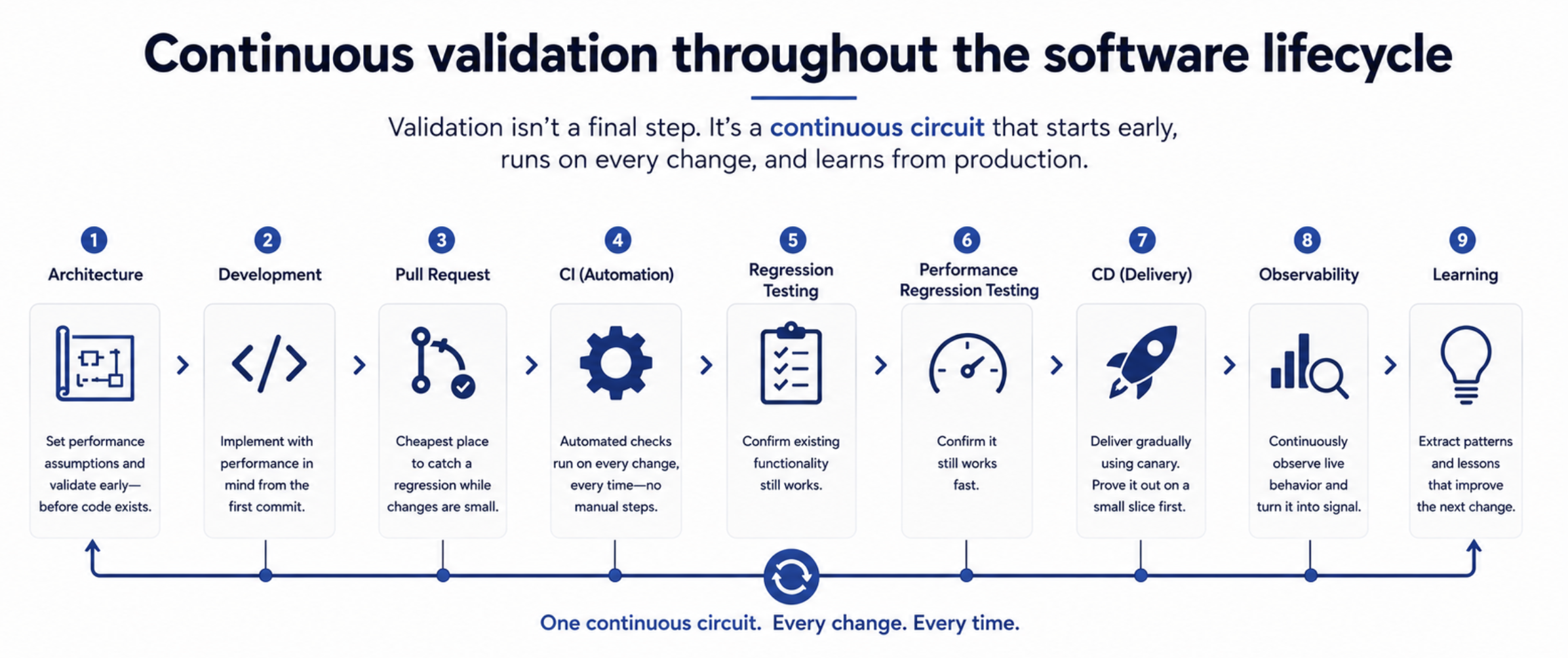
Architecture is where performance assumptions get set in the first place — this is the earliest point validation can start, even before code exists. Development is where those assumptions get implemented, ideally with performance in mind from the first commit. The pull request stage is the cheapest place to catch a regression, because the change is small and still fresh in the author's head. CI runs the automated checks that used to require a person, every time, on every change.
From there, regression testing confirms existing functionality still works, and performance regression testing confirms it still works fast. CD delivers the validated change into the world gradually rather than all at once, using a canary to prove it out on a small slice of real traffic before going to everyone. Once in production, observability keeps watching, turning live behavior into signal. That signal feeds learning — the patterns and lessons that shape the next commit, closing the loop and starting the cycle over again.
No single stage in that chain is new. What's different is treating them as one continuous circuit instead of a series of disconnected checkpoints.
Performance regression should be automated
Most teams still think about performance testing as a discrete event: someone runs a load test, reads a report, and moves on. Continuous Validation asks for something more automatic a running comparison against where the system used to be.
That starts with a baseline: what does normal look like right now? From there, you're watching the trend — is normal drifting, even slowly, in the wrong direction? And you're watching for regressions in the specific dimensions that tend to slip without anyone noticing: latency regression (requests getting slower), throughput regression (the system handling less volume than it used to), memory regression (creeping consumption that eventually tips into instability), and startup regression (services taking longer to become ready, which matters a lot more once you're autoscaling).
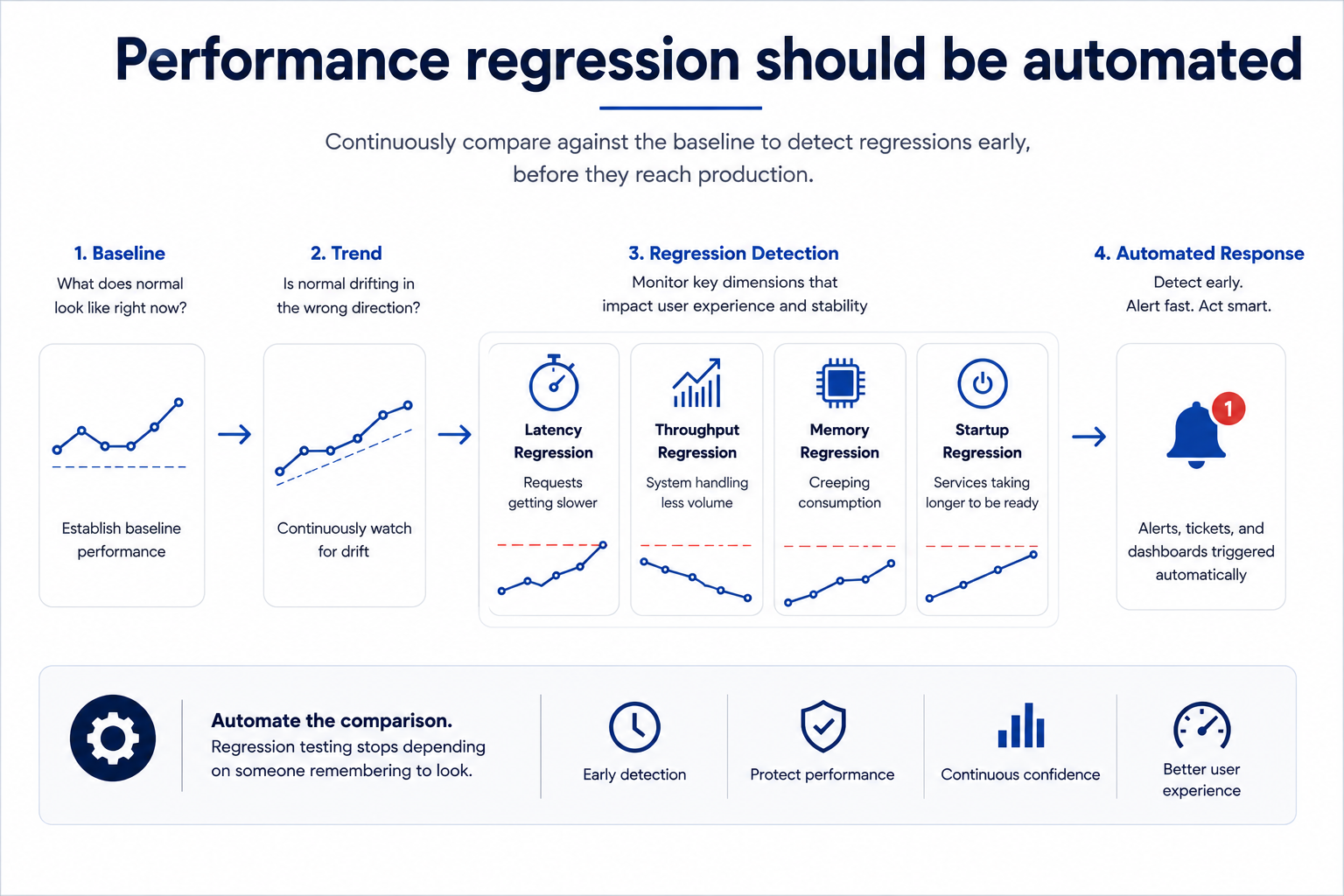
None of these require a human to notice them if the system is built to notice them itself. That's what makes this practical rather than aspirational: automate the comparison, and regression testing stops depending on someone remembering to look.
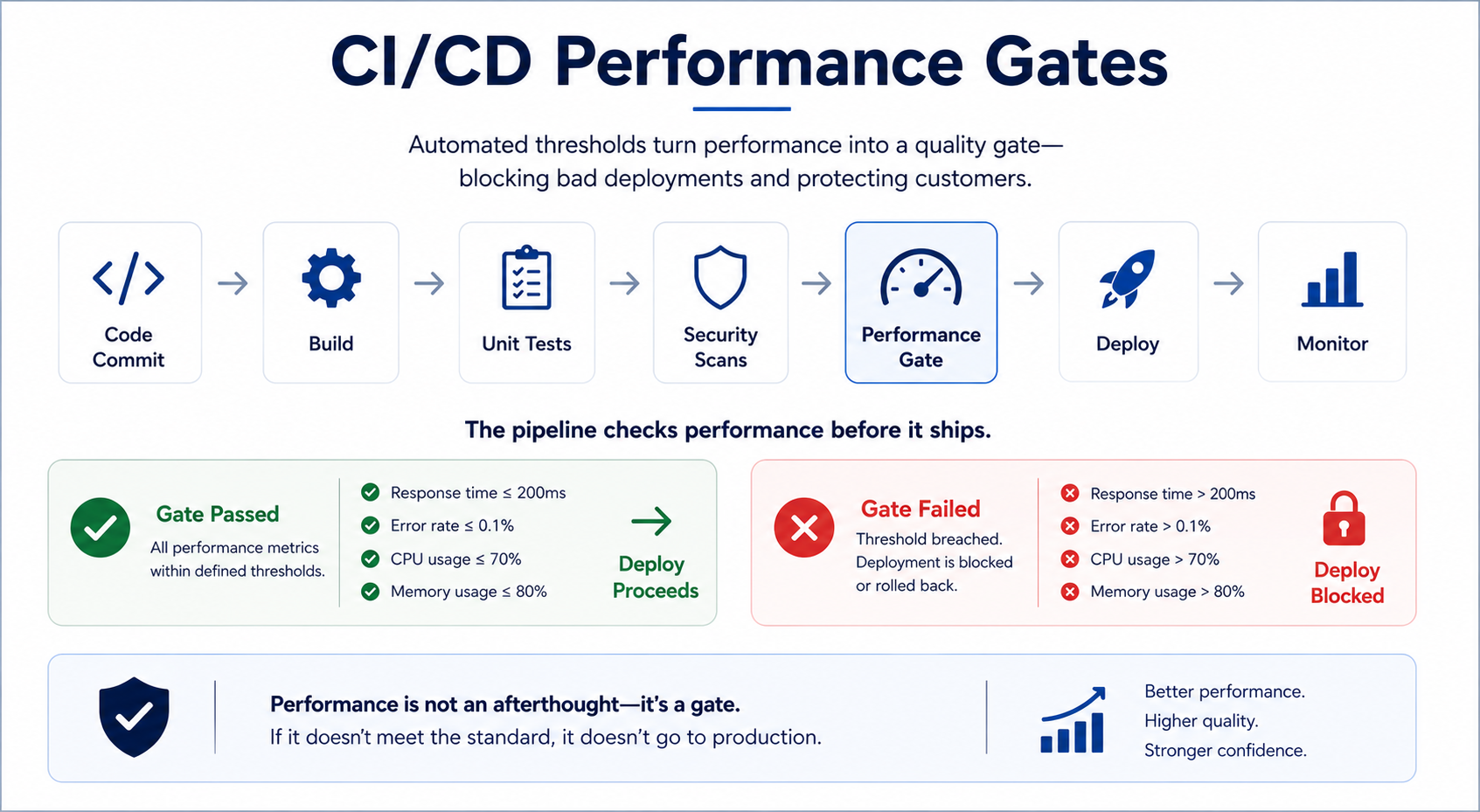
CI/CD performance gates
Automating the comparison only matters if something acts on the result. That's what a performance gate does: it takes an automated threshold — response time, error rate, resource usage — and makes it a condition of deployment, the same way a failing unit test blocks a merge.
If a build breaches the threshold, the pipeline can halt the deployment or trigger an automatic rollback before customers ever see the regression. This turns performance into a genuine quality gate, sitting right alongside functional tests and security scans, instead of a separate process that runs on its own schedule. The result is a different kind of deployment confidence — not "we hope this is fine" but "the pipeline already checked, and it is."
Canary deployments build confidence gradually
Even with strong automated gates, no test environment perfectly replicates production traffic. Canary deployments close that gap by proving a change out gradually, on real traffic, before it reaches everyone.
A typical rollout might move from 1% of traffic, to 5%, to 20%, and finally to 100% — pausing at each stage to check that latency, error rates, and resource usage are holding steady before expanding further. If something looks wrong at 5%, you've exposed a tiny fraction of customers instead of all of them, and you can roll back before it becomes an incident.
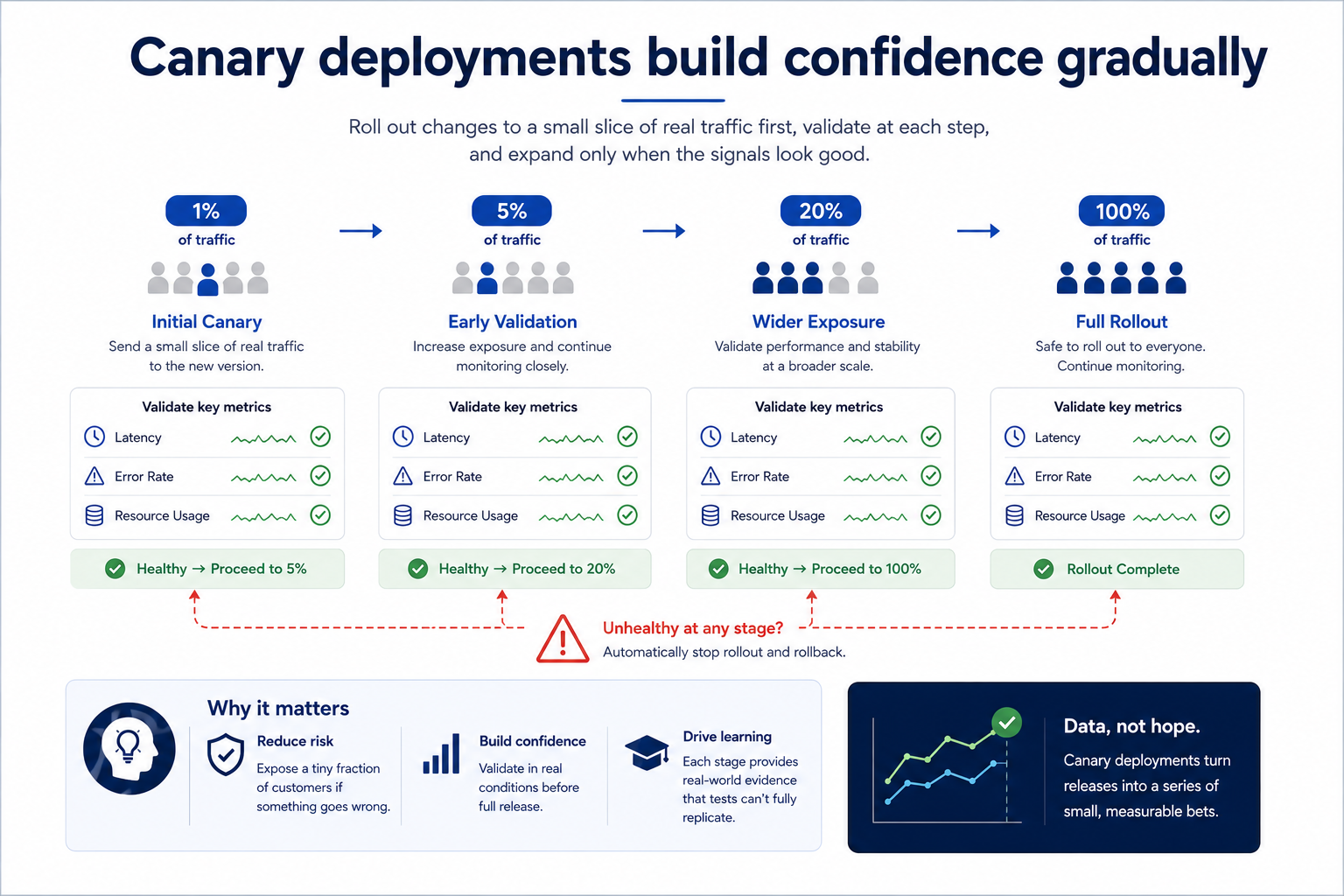
The real value here isn't just risk reduction. It's engineering learning: each stage of a canary rollout gives the team fresh evidence about how the change behaves under real conditions, which is exactly the kind of information a pre-release test environment can't fully replicate.
Synthetic monitoring extends validation beyond deployment
Canary deployments validate a change as it rolls out. Synthetic monitoring validates the system continuously, whether or not anything just changed.
The idea is to run synthetic journeys scripted transactions that mimic real customer behavior against production on a schedule, around the clock. Think of it as customer simulation: log in, search, add to cart, check out, repeated every few minutes, whether or not a real customer happens to be doing it at that moment. Synthetic checks catch problems before real users do, and they give you a clean way to track performance against your SLA independent of actual traffic volume.
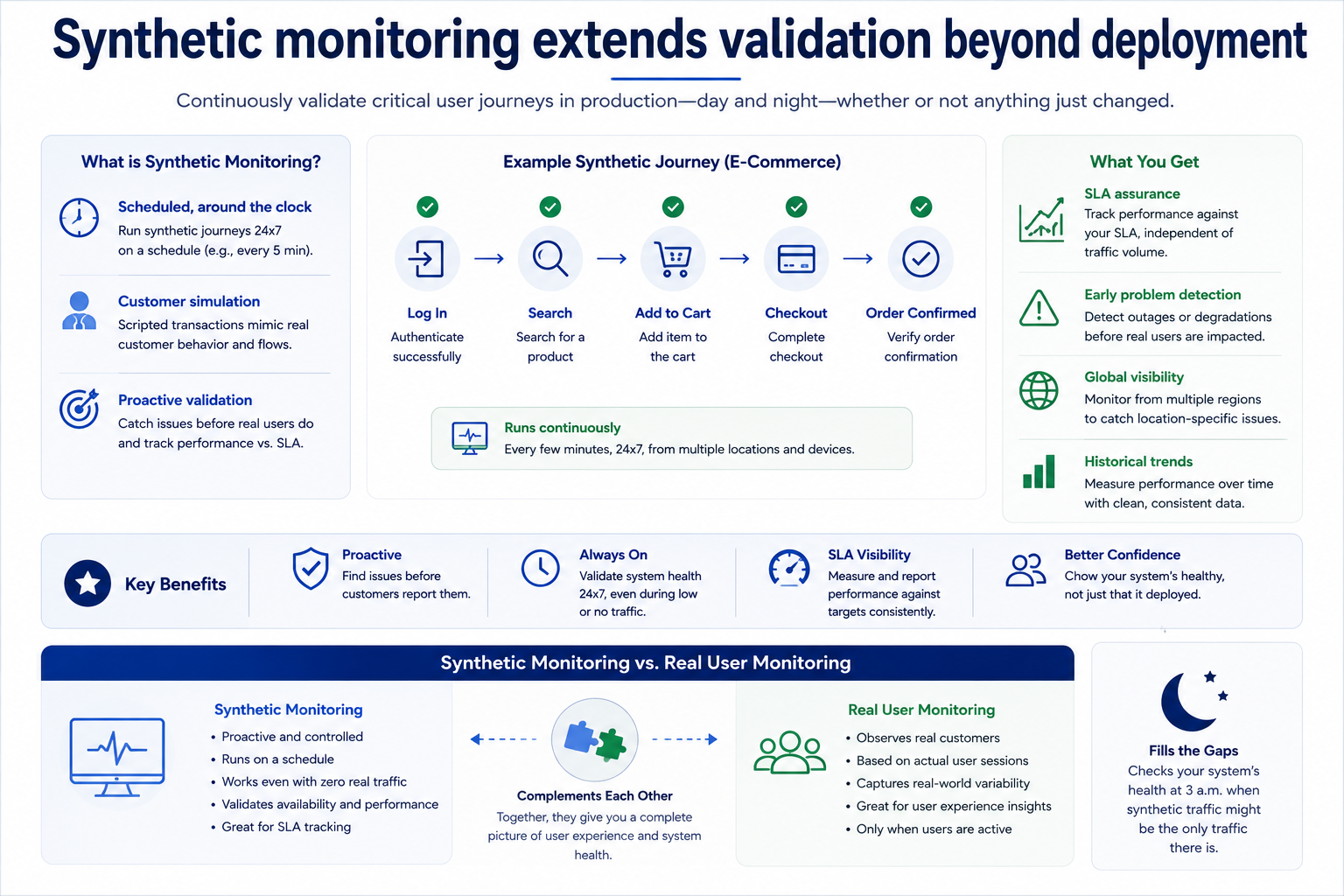
This complements real user monitoring, which tells you what's actually happening to real customers, but only when they happen to be using the system. Synthetic monitoring fills the gaps checking the system's health at 3 a.m. when synthetic traffic might be the only traffic there is.
Enterprise perspective
I once worked on a payment authorization platform where every transaction had to clear an EMVCo-certified Access Control Server within a strict latency window the kind of system where a slow response doesn't just annoy a customer, it can fail a transaction outright.
The platform passed every pre-release performance test without issue. But a few months after a routine update, response times started drifting upward during specific traffic windows nothing dramatic, just a slow creep that wouldn't have shown up in any single test run. It took canary-stage monitoring and ongoing observability, not the original performance test, to catch it: a downstream dependency had changed its own performance characteristics slightly, and the shift only became visible once we were watching continuously instead of checking once.
Nothing about that story is unique to payments. The same pattern shows up anywhere a system depends on other systems that keep changing on their own schedule — which, at this point, is nearly everywhere. Continuous validation is what catches a drift like that while it's still small enough to fix quietly, instead of finding out about it during an incident.
Continuous validation in the AI era
Traditional software runs on static logic: given the same input, it produces the same output, until a human changes the code. That assumption is exactly what a single pre-release performance test relies on validate the logic once, and it stays valid until the next deployment.
AI-driven components break that assumption entirely. They produce dynamic behavior: the same request can behave differently as a prompt gets tweaked, a model gets updated, a vector database gets re-indexed, or an agent's orchestration logic changes how it chains calls together. None of that requires a code deployment at all which means none of it would be caught by validation that only runs at deployment time.
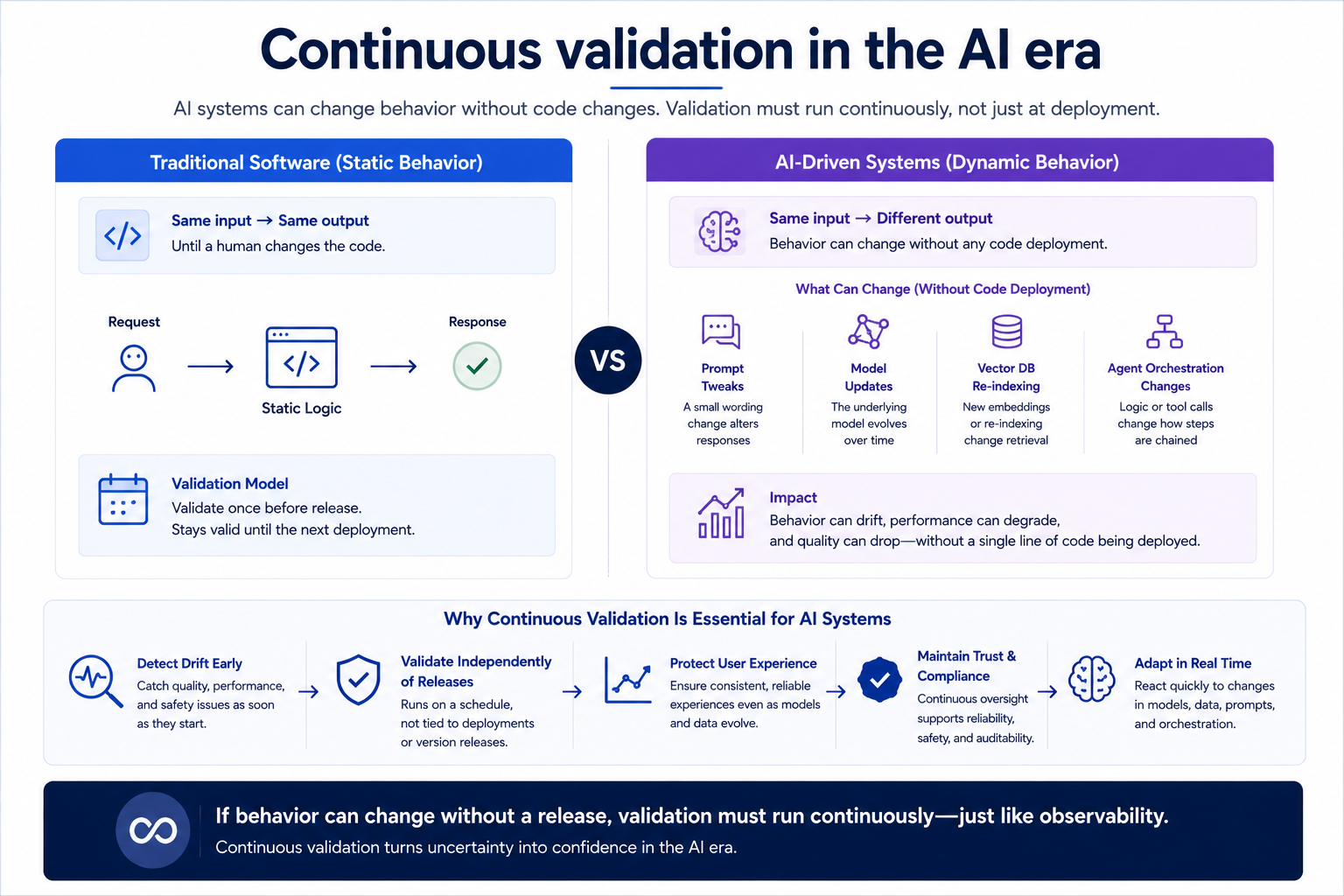
This is where Continuous Validation stops being a nice-to-have and becomes close to mandatory. If the system's behavior can drift without a release, then validation has to run independently of releases too continuously, the same way observability does.
Continuous confidence
Here's the piece I think gets missed most often: Continuous Validation isn't really the end goal. It's the mechanism. What it actually produces is something bigger Continuous Confidence.
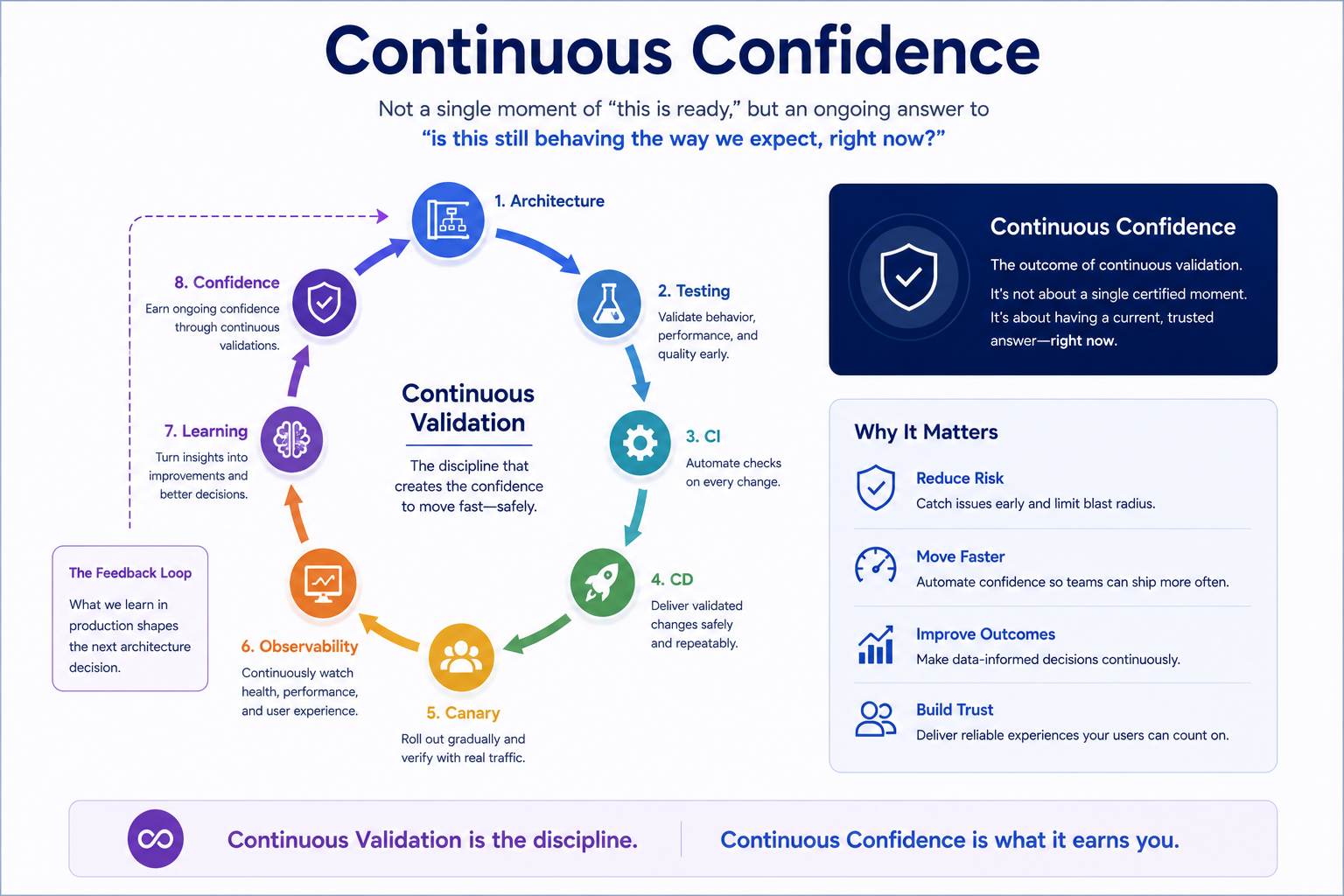
Each stage in that chain feeds the next, and the last stage feeds back into the first — what you learn in production shapes the next architecture decision. Continuous Validation is the discipline. Continuous Confidence is what it earns you: not a single certified moment of "this is ready," but an ongoing, current answer to "is this still behaving the way we expect, right now?"
Engineering takeaways
Confidence has a shelf life.
Validation should continue after deployment, not stop at it.
Performance regression should be automated, not manually re-checked.
Observability validates engineering assumptions in real time.
Canary deployments reduce uncertainty by proving changes out gradually.
AI increases the need for continuous validation, since behavior can drift without a release.
Continuous Validation builds Continuous Confidence.
SCALE Insight
Testing verifies software. Continuous Validation verifies engineering decisions. The outcome isn't simply better testing, the outcome is Continuous Confidence.
Next in the SCALE Framework Series
Article 6 – Architecture for Scale: Building Confidence Through Every Change, Not Every Release
Previous read
The SCALE Framework
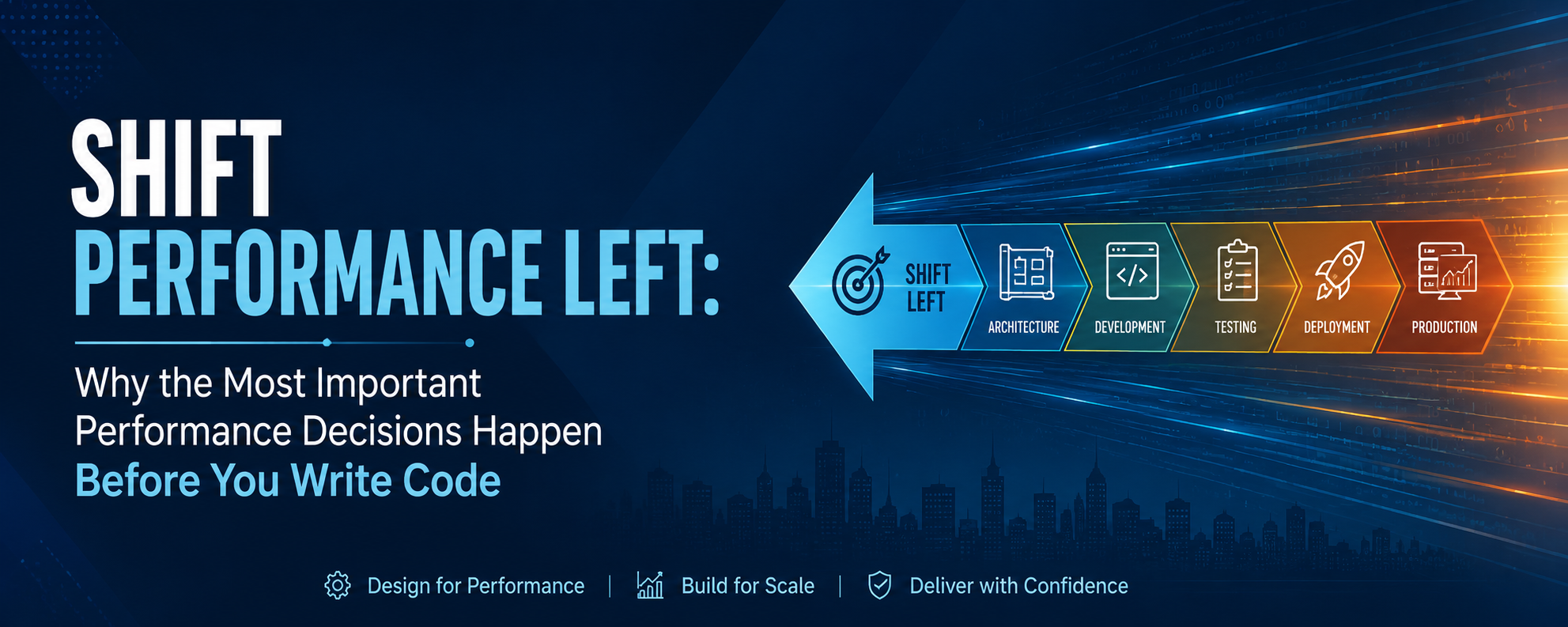
Shift Performance Left: Why the Most Important Performance Decisions Are Made Before the First Line of Code
Suggested next read
The SCALE Framework
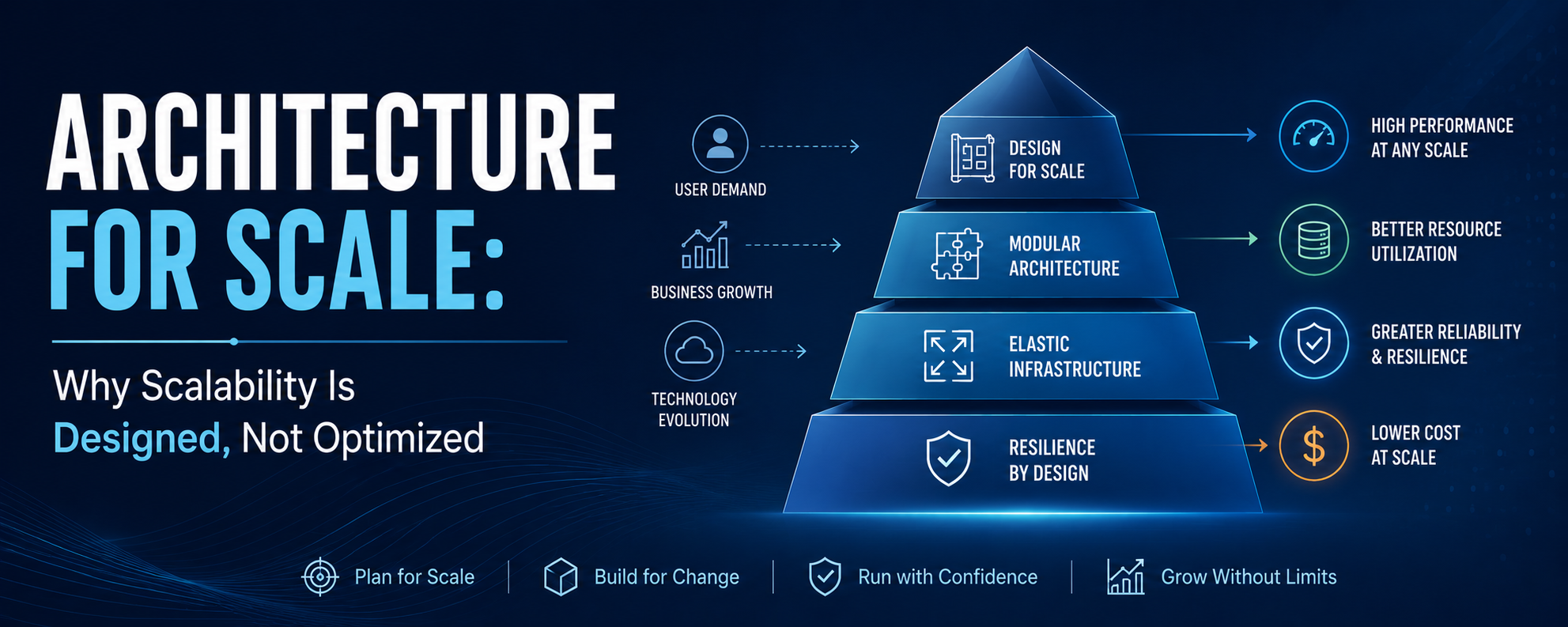
Architecture for Scale: Why Scalability Is Designed, Not Optimized
Comments (0)
No comments yet. Be the first!