 © Ram Brij
The SCALE Framework
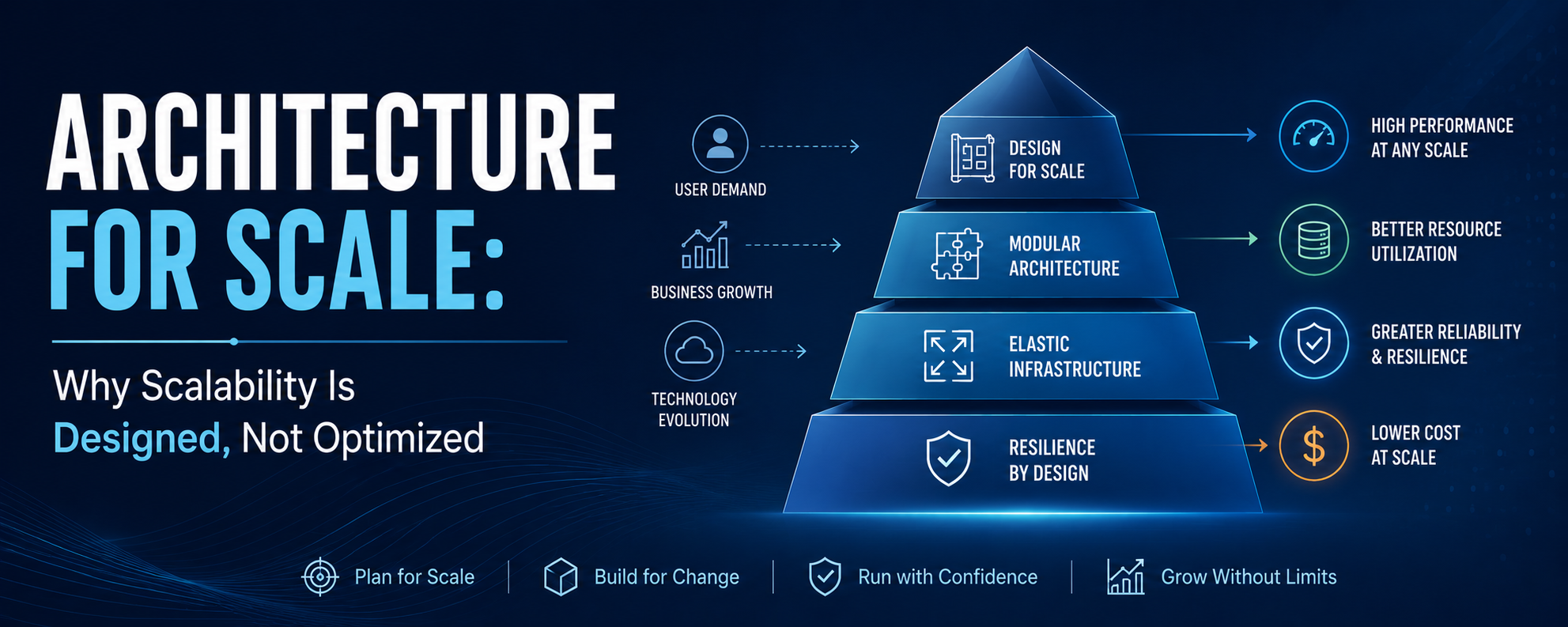
Architecture for Scale: Why Scalability Is Designed, Not Optimized
📘 About this Series
The SCALE Framework Series explores the SCALE Framework, an original methodology for Continuous Performance Engineering developed by Ram Brij through years of enterprise software engineering and technology leadership. Each article builds on the previous one, gradually introducing the framework's philosophy, principles, and practical implementation.
You're reading: Part 6 – Architecture for Scale: Why Scalability Is Designed, Not Optimized
Architecture for Scale
Why scalability is designed, not optimized
Performance and scalability get treated as the same thing so often that it's worth separating them plainly: performance is how fast a system responds. Scalability is whether it keeps responding that way as load grows. A system can be fast and still not be scalable — and that gap is where a lot of expensive surprises come from.
Here's a simple way to picture it. Imagine a system that responds in 80 milliseconds under normal conditions genuinely fast, by any measure. Now put 500 concurrent users on it, and it falls over. The 80-millisecond number wasn't wrong. It just never told you anything about what happens under load, because performance and scalability answer two different questions. One tells you how well the system works. The other tells you how far that "well" actually extends.
That distinction is the whole idea behind the third principle of the SCALE Framework: Architecture for Scale. Scalability isn't something you bolt onto a working system after the fact through clever optimization. It's something you either designed for from the start, or you didn't.
Why stateless services scale
The interesting question here isn't "what is a stateless service" most engineers already know the definition. The more useful question is why statelessness actually buys you scalability in practice.
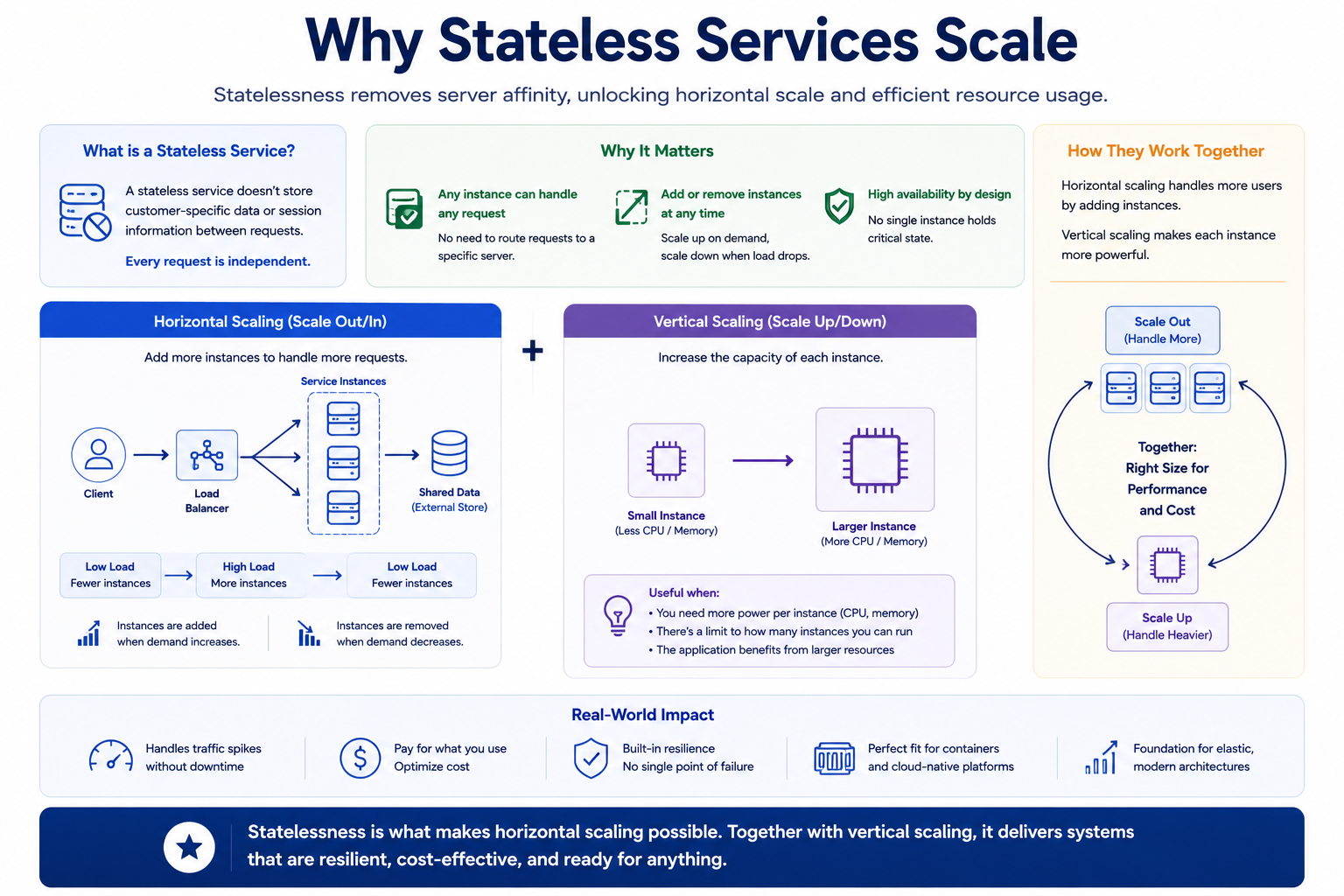
A stateless service doesn't remember anything about the customer between requests no session data sitting in memory, no assumption that the next request from this customer will hit the same server as the last one. That sounds like a small detail, but it changes everything about how the system can grow. If any instance can handle any request, you can add more instances whenever load increases, and remove them whenever it drops, without worrying about which instance is "holding" a particular customer's state.
This is exactly why payment APIs and authorization services are almost always built stateless: a card authorization can't afford to fail because the one server that "remembered" the transaction happened to be busy or restarting. Containers make this pattern easy to run at scale, and autoscaling makes it pay off automatically new instances spin up under load and disappear when it passes, with no coordination required. Statelessness isn't an implementation detail. It's what makes horizontal scaling possible in the first place.
Horizontal scaling
There are two ways to handle more load: make each machine more powerful (scale up), or add more machines (scale out). Scaling up has a ceiling there's a limit to how big one box can get, and it usually gets expensive well before you hit it. Scaling out doesn't have that ceiling, which is exactly why enterprise systems almost always choose horizontal growth once they're operating at any real scale.
Horizontal scaling depends on a few things working together: a load balancer to spread requests across instances, containers to make each instance easy to start and stop, cloud infrastructure to provide the capacity on demand, and an orchestrator like Kubernetes to manage all of it automatically. None of these pieces do much on their own. Together, they're what let a system absorb a traffic spike by adding capacity in minutes instead of redesigning the application under pressure.
Vertical Scaling
Vertical scaling takes the opposite approach: instead of adding more machines, you give the existing one more resources more CPU, more memory, a faster disk. It's usually the first move a team makes, and for good reason. It requires no architectural change at all. No load balancer to configure, no session-handling rework, no distributed-systems complexity to introduce. You resize the box, restart the service, and the same code runs faster or handles more.
That simplicity is exactly where its limits show up. Every piece of hardware has a ceiling a maximum CPU count, a maximum memory size, a maximum I/O throughput one machine can push and once you're near that ceiling, bigger instances get disproportionately expensive well before they buy you meaningful headroom. It also leaves you with a single point of failure: if that one larger machine goes down, there's no second instance standing by to take over.
Vertical scaling isn't wrong, it's just limited in scope. It works well for stateful systems that resist easy horizontal partitioning, like a primary database node, or for smaller applications where the cost and complexity of horizontal infrastructure isn't yet justified by the traffic. But it's a ceiling you eventually hit, not a strategy that scales indefinitely which is exactly why most enterprise systems treat it as a starting point rather than a destination, and reach for horizontal scaling once real growth kicks in.
Events change everything
This is where event-driven architecture comes in, but the goal here isn't to teach you how Kafka works plenty of documentation already does that well. The goal is to understand the tradeoff underneath it: when should a request wait for an answer, and when should it just hand off the work and move on?
Synchronous communication makes sense when the caller genuinely needs the result before it can proceed authorizing a payment before showing the customer a confirmation screen, for instance. Asynchronous communication makes sense when the caller doesn't need to wait at all sending a receipt email, updating a recommendation model, logging an analytics event. Forcing the second kind of work through a synchronous call just adds waiting that serves no purpose, and that waiting is exactly what breaks down first under load.
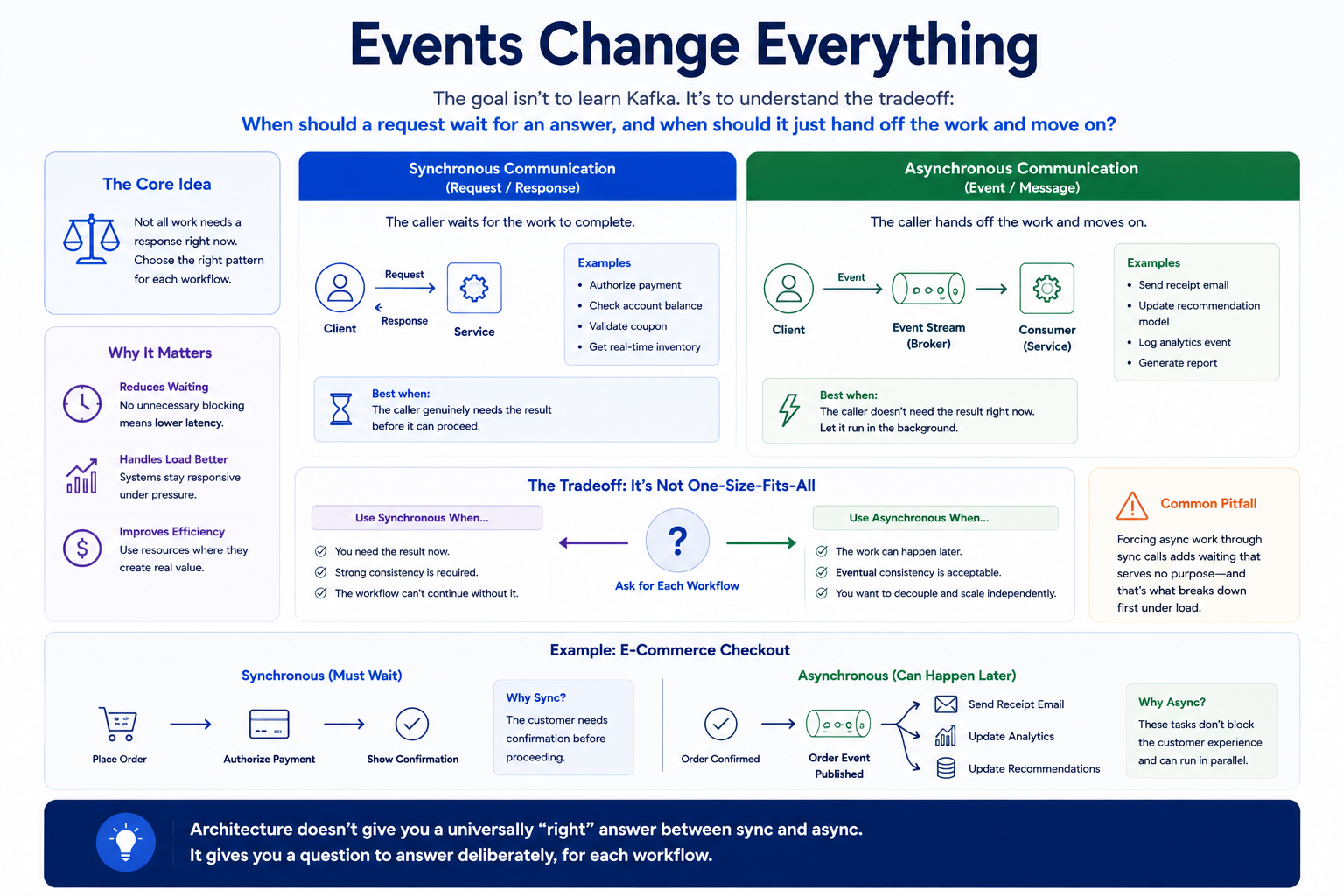
This is the same tradeoff conversation from the architecture decisions we covered when we talked about shifting performance left: architecture doesn't hand you a universally "right" answer between synchronous and asynchronous. It hands you a question you need to answer deliberately, for each workflow, instead of defaulting to whichever one was easier to build first.
Architecture separates reads from writes
One architectural pattern that's had a real impact on large-scale systems is CQRS (Command Query Responsibility Segregation). The name sounds intimidating, but the idea behind it is simple: the way a system writes data is often very different from the way it reads it.
Most applications start out using the same data model for both, and at smaller scale that's the right call, it keeps things simple. But read and write workloads rarely grow at the same rate, and eventually optimizing one database model for both stops being simplicity and starts being compromise.
Take a large e-commerce platform. When a customer places an order, that's a single write and it has to be accurate, consistent, and durable, because it records the purchase, updates inventory, kicks off payment processing, and triggers fulfillment. What happens to that order afterward looks completely different. The customer checks it while tracking delivery. Support pulls it up during a service call. Warehouse systems query it for fulfillment. A recommendation engine analyzes it for buying patterns. Inventory checks it against stock movements. Finance pulls it into reconciliation and revenue reports.
One write. Potentially thousands of reads over that order's lifetime. Once you see the workload in those terms, treating reads and writes as the same operation stops making sense.
CQRS lets each side evolve on its own terms instead of forcing one model to serve two very different jobs. The write side stays focused on transactional consistency and business rules. The read side gets optimized for speed, search, reporting, and caching — without either side dragging the other down. It's not complexity for its own sake; it's matching the solution to the actual shape of the problem.
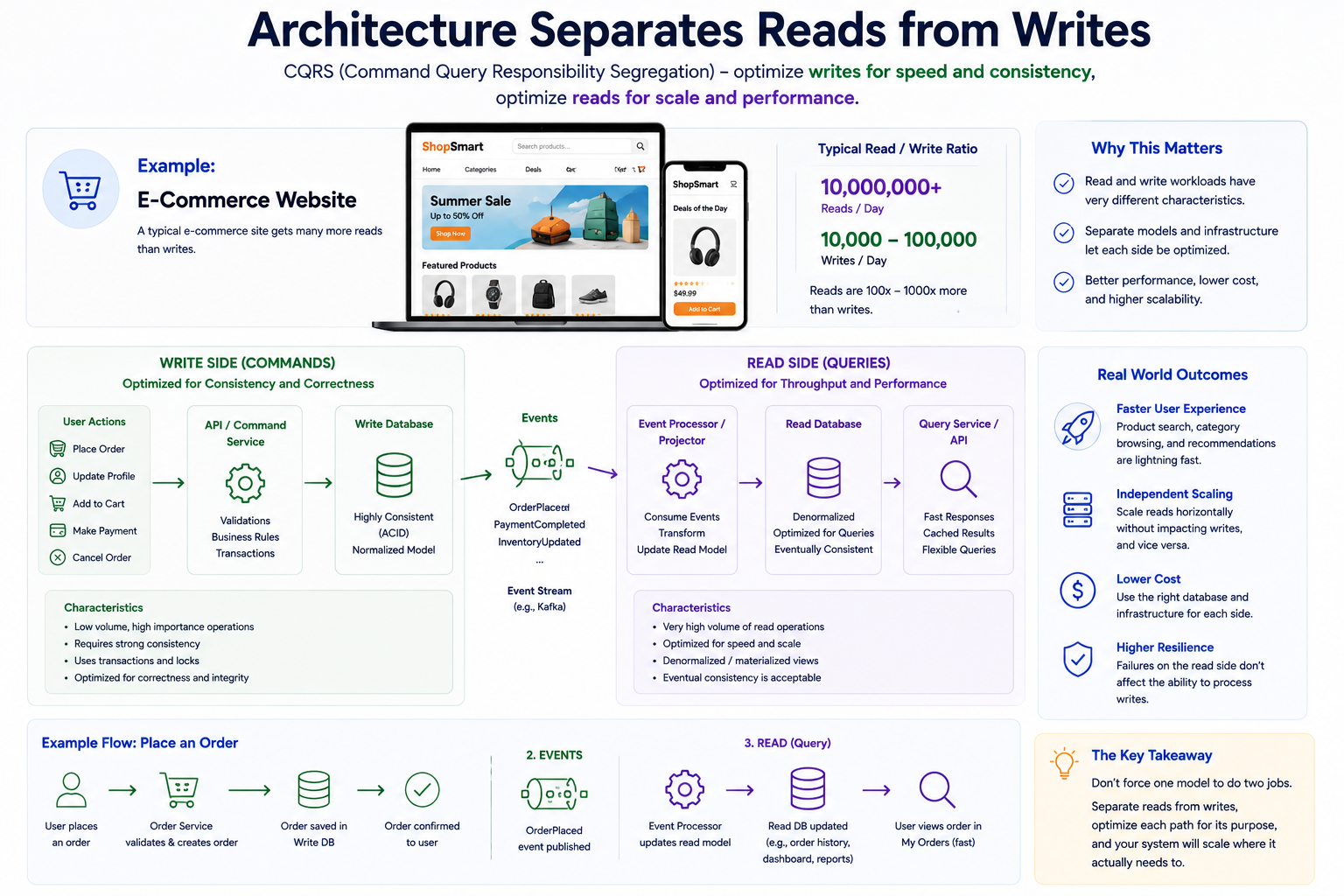
Like any architectural choice, it comes with tradeoffs more moving parts, a need for synchronization between the two models, and usually eventual consistency instead of immediate consistency. For a system with modest traffic, that overhead often isn't worth it. For a platform serving millions of users, separating reads from writes tends to be exactly what keeps the data model from becoming the thing holding the system back.
The takeaway isn't that every application needs CQRS. It's that architecture should follow the actual shape of your workload, not force every workload into the same pattern. Designing for scale means spotting that shape early, before growth exposes where it's straining.
Resilience creates scalability
Timeouts, retries, circuit breakers, bulkheads, fallback logic, idempotency these usually get taught as a list of separate resilience patterns. The more important point is that they don't work in isolation. They work as a system, and scalability depends on that system holding together.
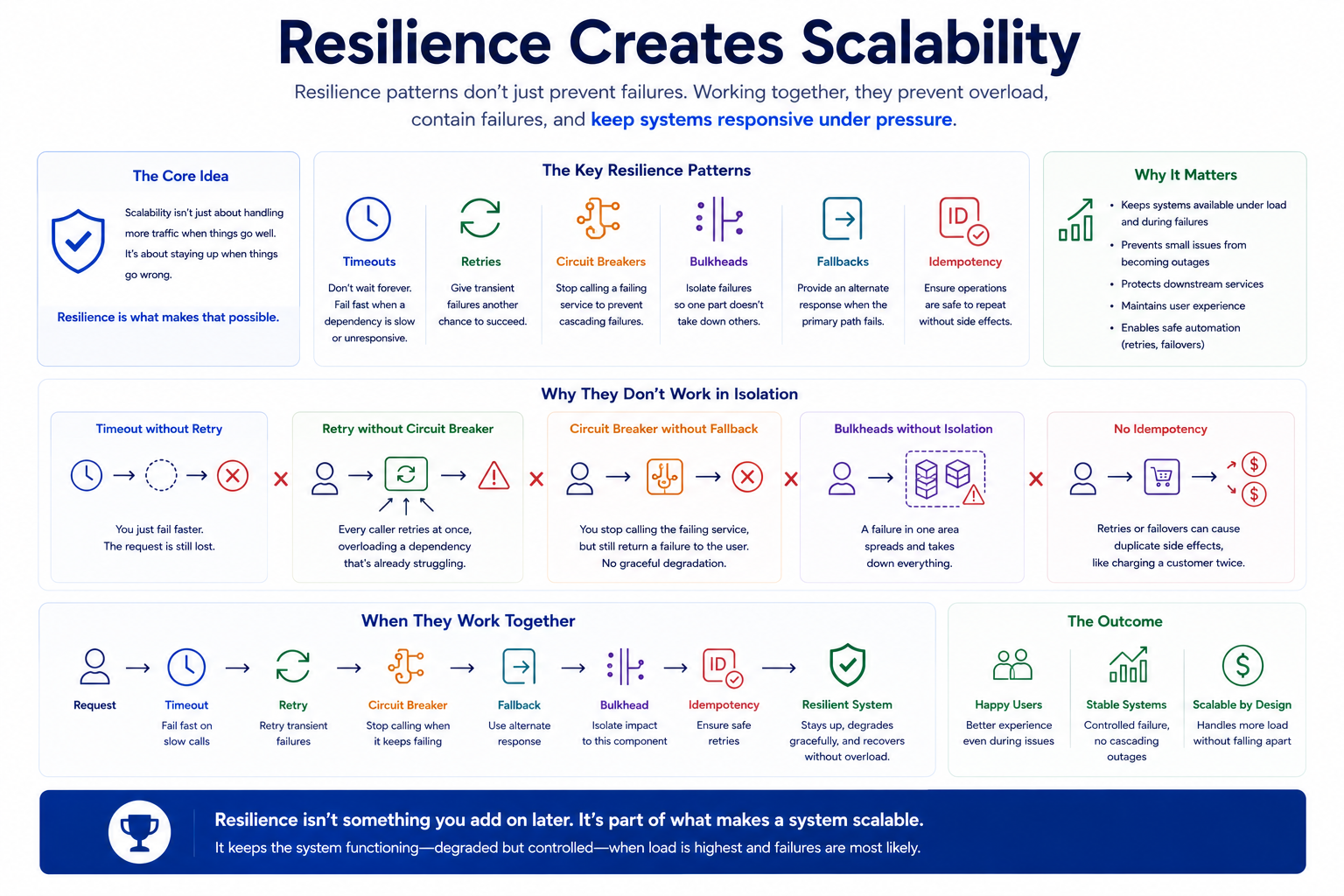
A timeout without a retry just means you fail faster. A retry without a circuit breaker can turn one slow dependency into a self-inflicted traffic storm, as every failed call retries at once and piles even more load onto something that was already struggling. A circuit breaker without a fallback just replaces one kind of failure with another. And none of it is safe to retry at all unless the underlying operation is idempotent safe to repeat without creating duplicate side effects, like charging a customer twice.
Put together, these patterns let a system keep functioning, in a degraded but controlled way, exactly when load is highest and failure is most likely. That's not a resilience feature bolted onto an already-scalable system, it's part of what makes the system scalable to begin with.
Databases scale because architects plan for it
Databases don't earn scalability by accident, and they don't lose it by accident either. Partitioning and sharding split data across multiple nodes so no single database has to hold everything. Read replicas take read traffic off the primary node so writes aren't competing with reads for the same resources. Careful indexing keeps lookups fast as data volume grows instead of degrading linearly with table size. Caching keeps the most frequently requested data out of the database entirely, cutting load before it ever reaches the disk.
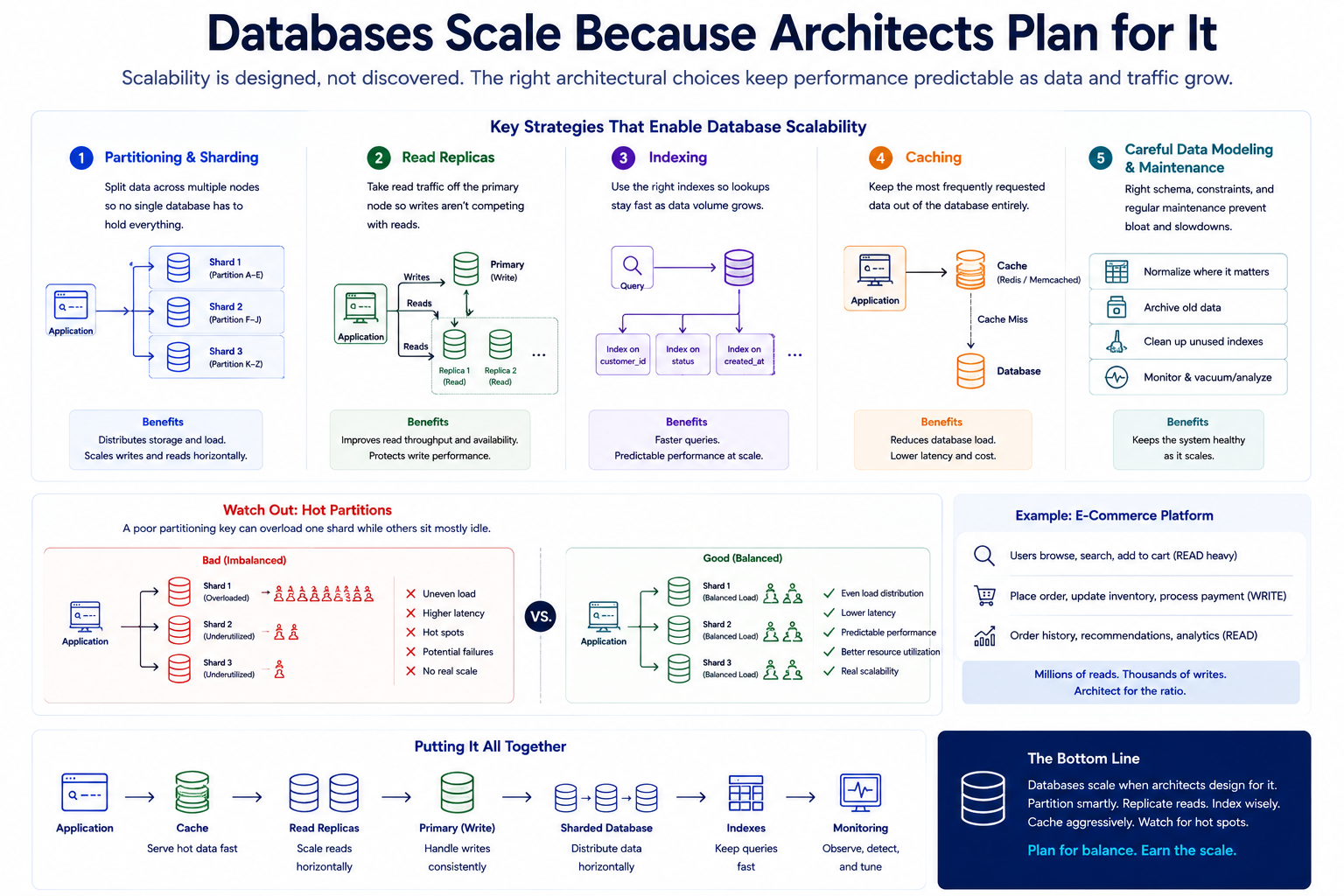
One thing worth watching for specifically: hot partitions, where one shard or partition ends up handling far more traffic than the others because the partitioning key wasn't chosen with real-world traffic patterns in mind. A system can be partitioned and still not be balanced the two aren't the same thing, and only one of them actually buys you scale.
Enterprise perspective
Real-time payment authorization is one of the clearer examples of what "architecture for scale" actually demands in practice. A card authorization typically has to travel through a distributed chain of decisions issuer checks, fraud scoring, an EMVCo-certified Access Control Server for 3-D Secure flows, all within a latency window measured in a few hundred milliseconds, because the customer is standing at a register or waiting on a checkout page the whole time.
What makes this kind of system hard to scale isn't any single component. It's that every one of those distributed decision points has to hold its own latency budget while throughput keeps climbing during a holiday shopping peak, for instance, when transaction volume can spike far beyond an average day without any warning. A system built for that has to treat scalability as a property of the whole chain, not just the busiest-looking piece of it. No architecture handles that kind of load by accident. It handles it because someone designed every link in that chain with scale as an explicit requirement, long before the first holiday traffic spike ever arrived.
AI changes architecture
AI-driven components introduce a genuinely new set of architectural questions, and they don't map cleanly onto the patterns above. An AI gateway now sits in front of model APIs, routing and managing requests the way an API gateway does for traditional services except the thing behind it doesn't respond in single-digit milliseconds. Agent orchestration adds chains of calls where one agent's output becomes another's input, multiplying latency and failure surface with every hop. Memory and prompt services need to be fast enough not to become the bottleneck in front of an already-slow model call.
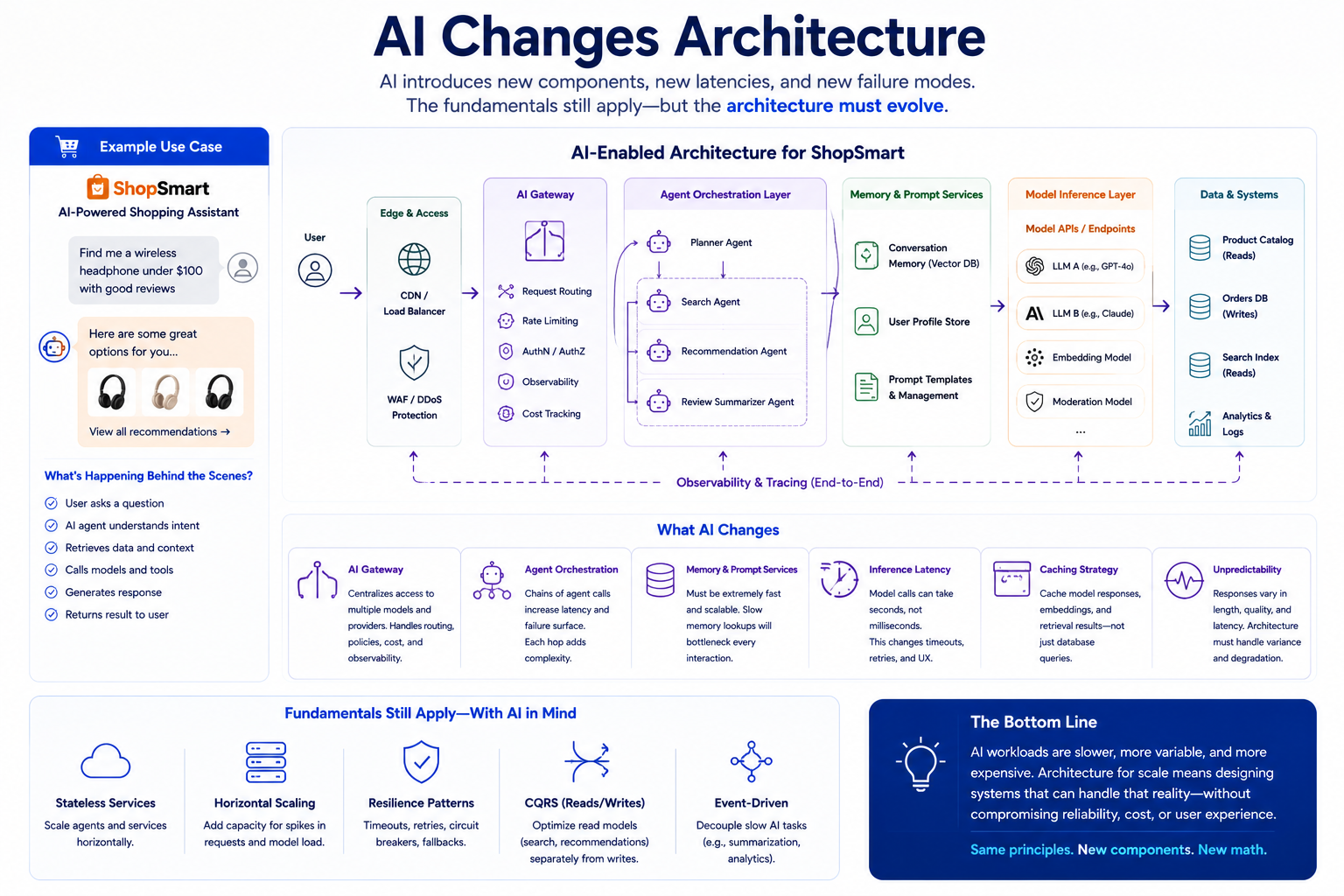
Inference latency changes the math entirely a model call can easily take longer than an entire traditional request used to take end to end, which means caching strategy has to expand to cover model responses, not just database queries. This is architecture for scale applied to a new kind of workload: the fundamentals statelessness, horizontal scaling, resilience, careful separation of read and write paths still apply, but they now have to account for components that are inherently slower and less predictable than the services they sit alongside.
Architecture within SCALE
Architecture for Scale doesn't stand alone it's one link in a chain that runs through the whole framework:
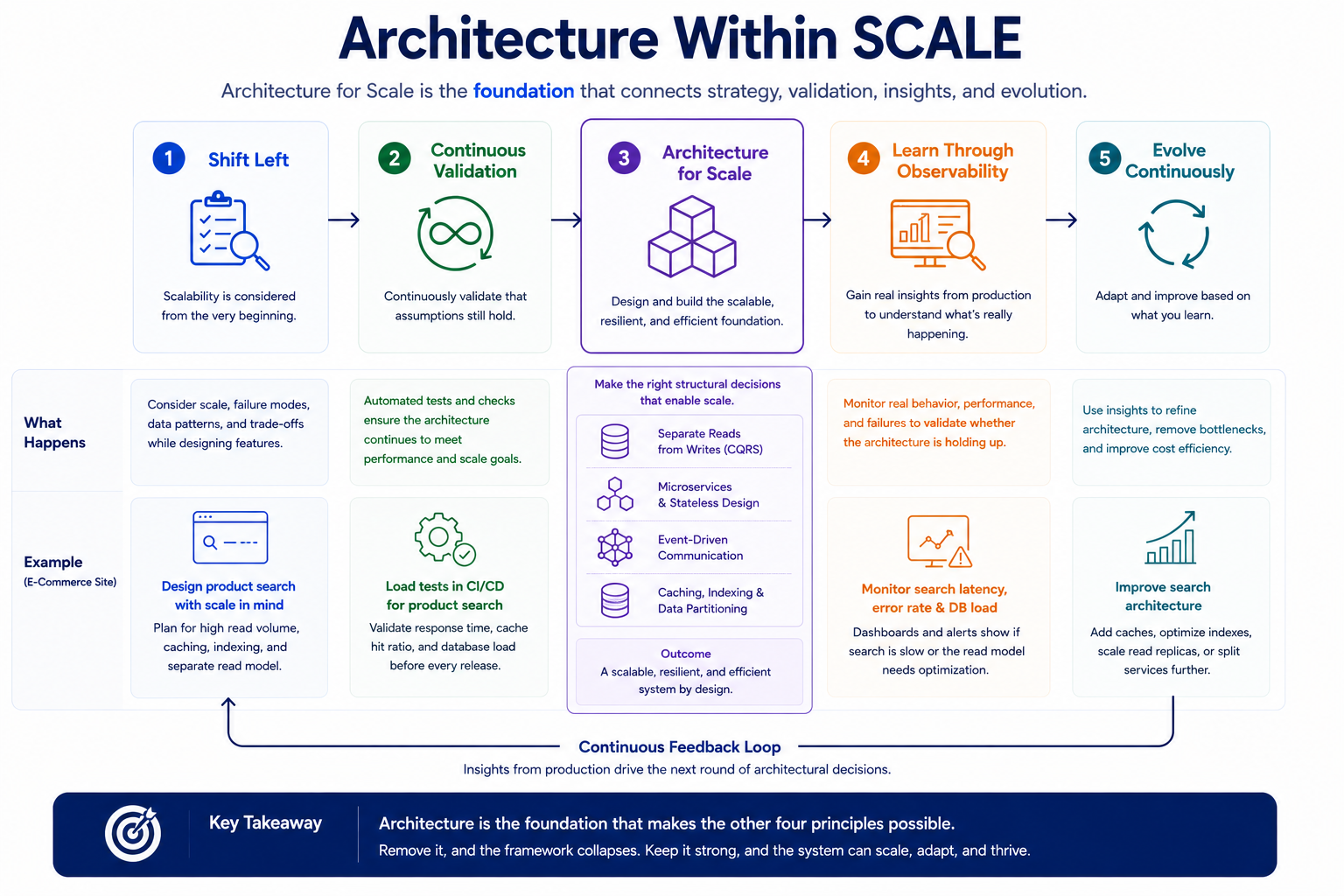
Shifting left is where scalability first gets considered. Continuous Validation is what confirms those architectural assumptions still hold as the system changes. Architecture for Scale is the foundation those assumptions get built on. Observability is what tells you, in production, whether the architecture is actually holding up the way it was designed to. And evolving continuously is what happens when it isn't — feeding back into the next round of architectural decisions. Pull architecture out of that chain, and the other four principles have nothing solid to stand on.
Engineering takeaways
Scalability is an architectural decision, not a tuning exercise.
Stateless systems scale more predictably than stateful ones.
Events remove waiting, not complexity choose sync vs. async deliberately.
Resilience enables growth; timeouts, retries, circuit breakers, and idempotency work as a system, not in isolation.
Databases determine long-term scalability through partitioning, replication, and caching decisions made early.
AI introduces new architectural bottlenecks that traditional scaling patterns don't fully address on their own.
Architecture is the foundation of Continuous Performance Engineering.
SCALE Insight
High-performing systems aren't accidentally scalable. They're intentionally architected to remain scalable long before customers ever notice the difference.
Next in the SCALE Framework Series
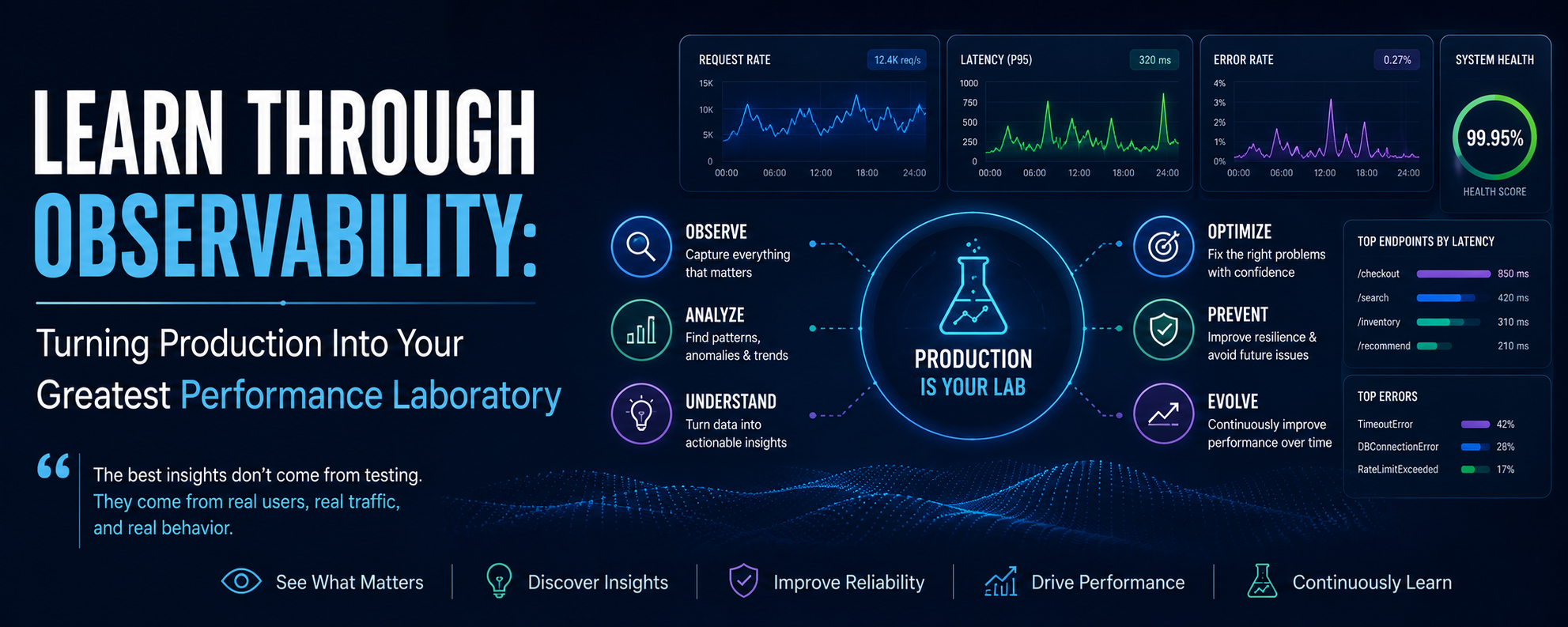
Article 7 – Learn Through Observability: Turning Production Into Your Greatest Performance Laboratory
Previous read
The SCALE Framework
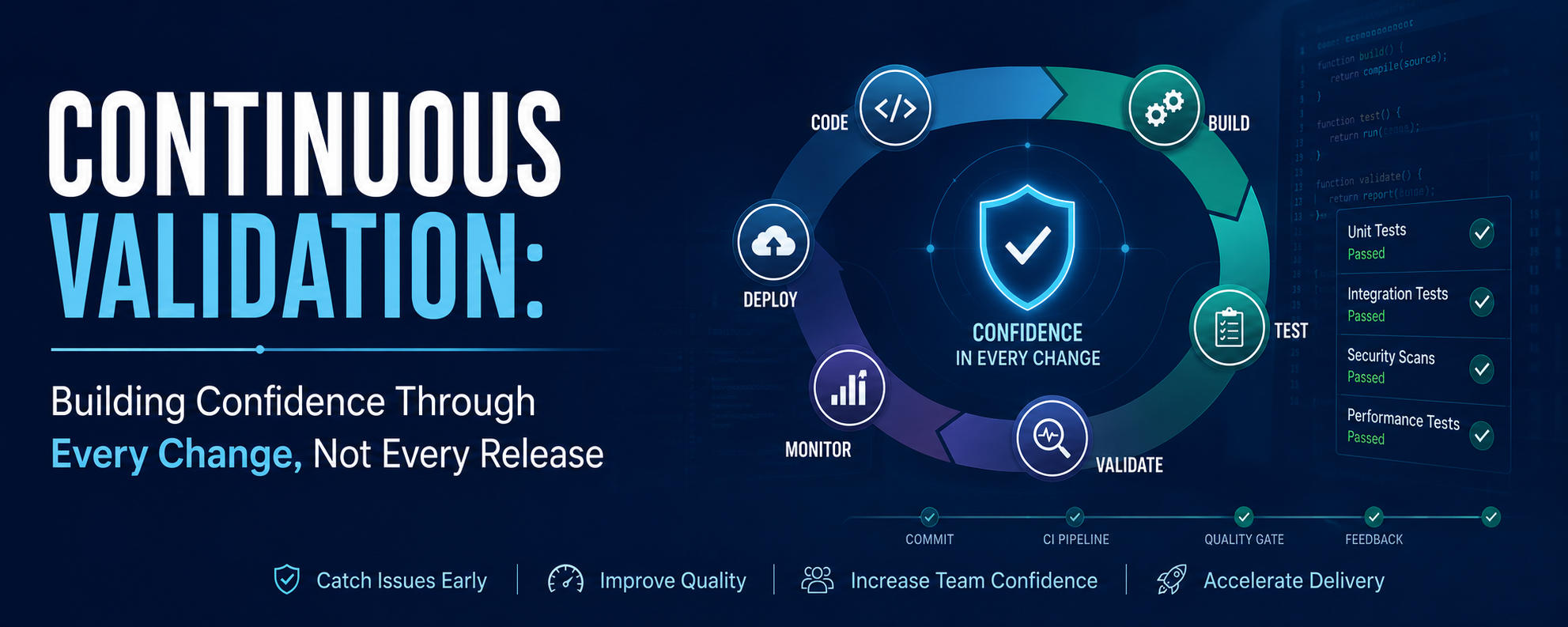
Continuous Validation: Building Confidence Through Every Change, Not Every Release
Suggested next read
The SCALE Framework
Learn Through Observability: Turning Production Into Your Greatest Performance Laboratory
Comments (0)
No comments yet. Be the first!