 © Ram Brij
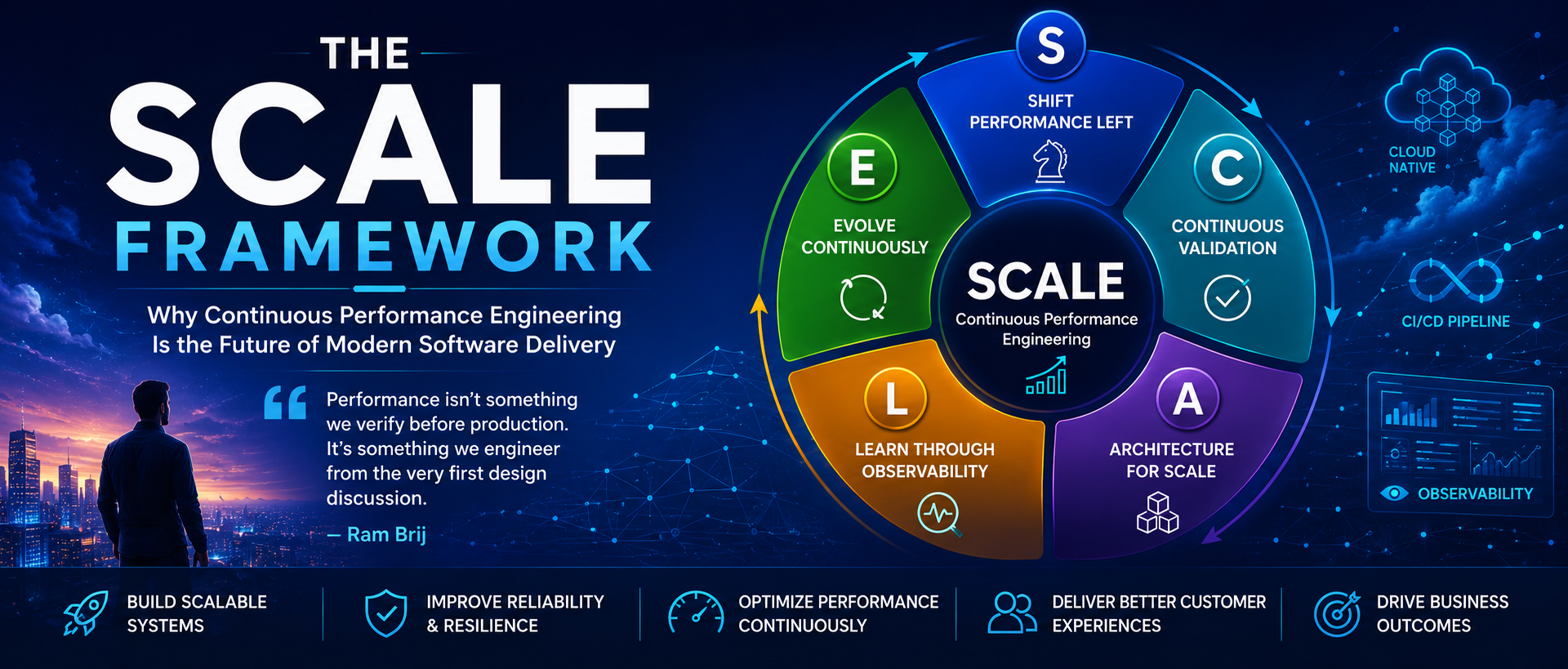
The SCALE Framework
Why Continuous Performance Engineering Is the Future of Modern Software Delivery
Performance isn't something we verify before production. It's something we engineer from the very first design discussion.
— Ram Brij
📘 About this Series
The SCALE Framework Series explores the SCALE Framework, an original methodology for Continuous Performance Engineering developed by Ram Brij through years of enterprise software engineering and technology leadership. Each article builds on the previous one, gradually introducing the framework's philosophy, principles, and practical implementation.
You're reading: Part 1 – The Spark Behind SCALE
The Spark Behind SCALE
Some of the most valuable lessons in software engineering never appear in architecture diagrams, performance reports, or postmortem documents. They accumulate quietly over years, one release at a time, one production incident at a time, one difficult engineering conversation at a time. You rarely recognize their significance while they are happening. It is only when you pause and look back that you realize those seemingly ordinary experiences have fundamentally changed the way you think.
When I began my career, I was fascinated by the elegance of software engineering. Like many engineers, I believed that building great software was primarily about writing clean code, designing robust architectures, choosing the right technologies, and following disciplined engineering practices. Performance, of course, was important, but it occupied a familiar place in the software delivery lifecycle. We designed the application, built the features, validated functionality, and eventually reached the phase where performance engineers executed load tests, analyzed reports, tuned bottlenecks, and gave the team confidence that the system was ready for production.
That process felt logical.
In many ways, it was.
For years, it served the industry remarkably well.
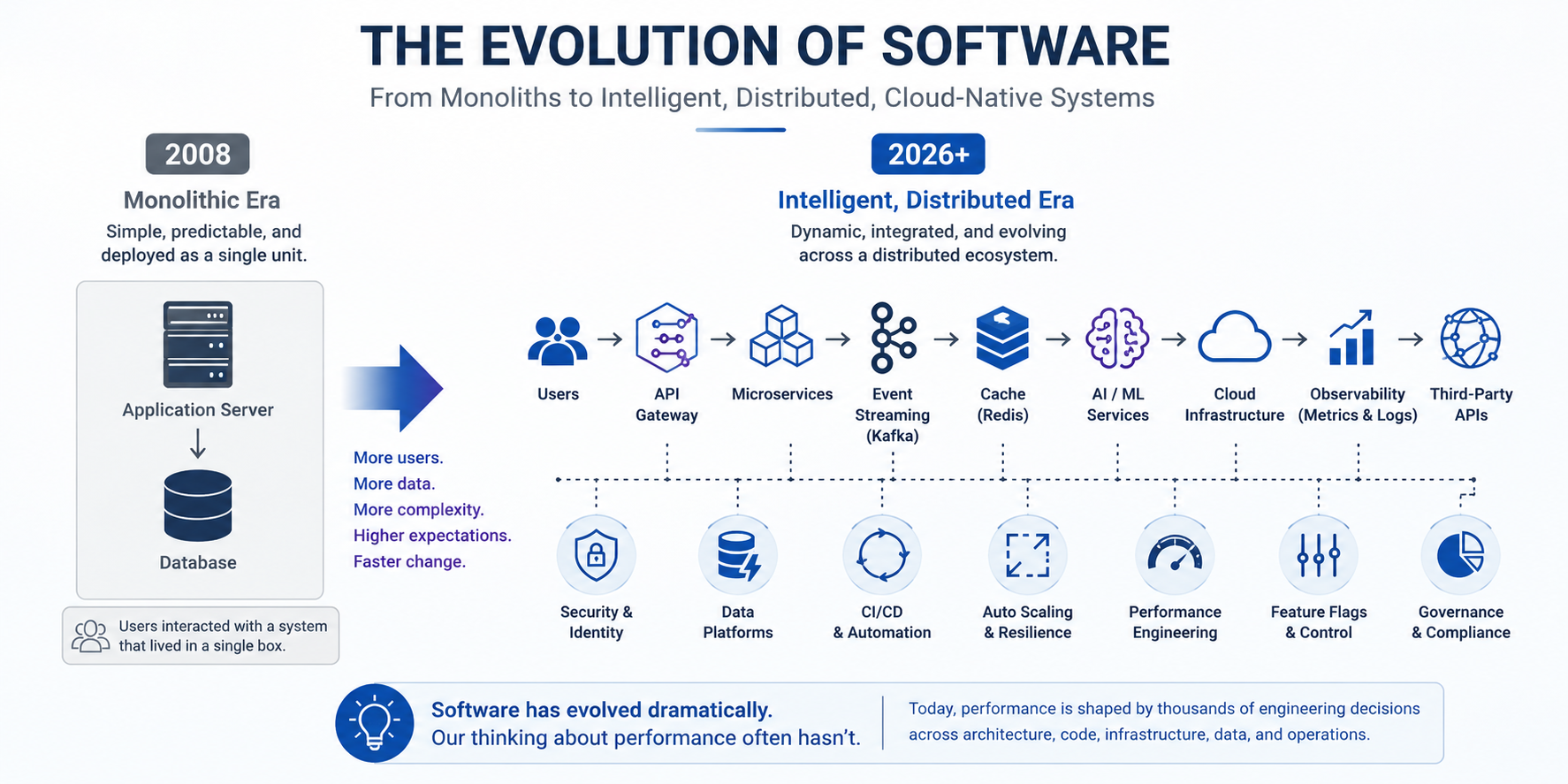
Applications were typically deployed as larger, self-contained systems. Infrastructure remained relatively stable. Release cycles were measured in months rather than hours. Performance testing near the end of a project provided a reasonable level of confidence because software itself behaved in reasonably predictable ways.
But software did not stand still.
The systems we build today bear little resemblance to the systems many of our engineering practices were originally designed to support.
A single customer request no longer travels through one application and one database. It may pass through dozens of independently deployed microservices, asynchronous messaging platforms, distributed caches, third-party APIs, cloud infrastructure, authentication providers, fraud engines, and increasingly, AI-powered services making decisions in real time. Every deployment introduces change into a living ecosystem rather than a single application. Every dependency evolves independently. Every service becomes both a consumer and a provider of functionality. Complexity is no longer something we intentionally design, it is something that naturally emerges as systems grow.
Yet despite this dramatic evolution in software architecture, one thing remained surprisingly familiar.
Almost every significant production incident I participated in was followed by a sentence that sounded almost identical.
"The performance tests passed."
I heard those words often enough that they eventually stopped sounding reassuring.
In fact, they became the beginning of a much more interesting conversation.
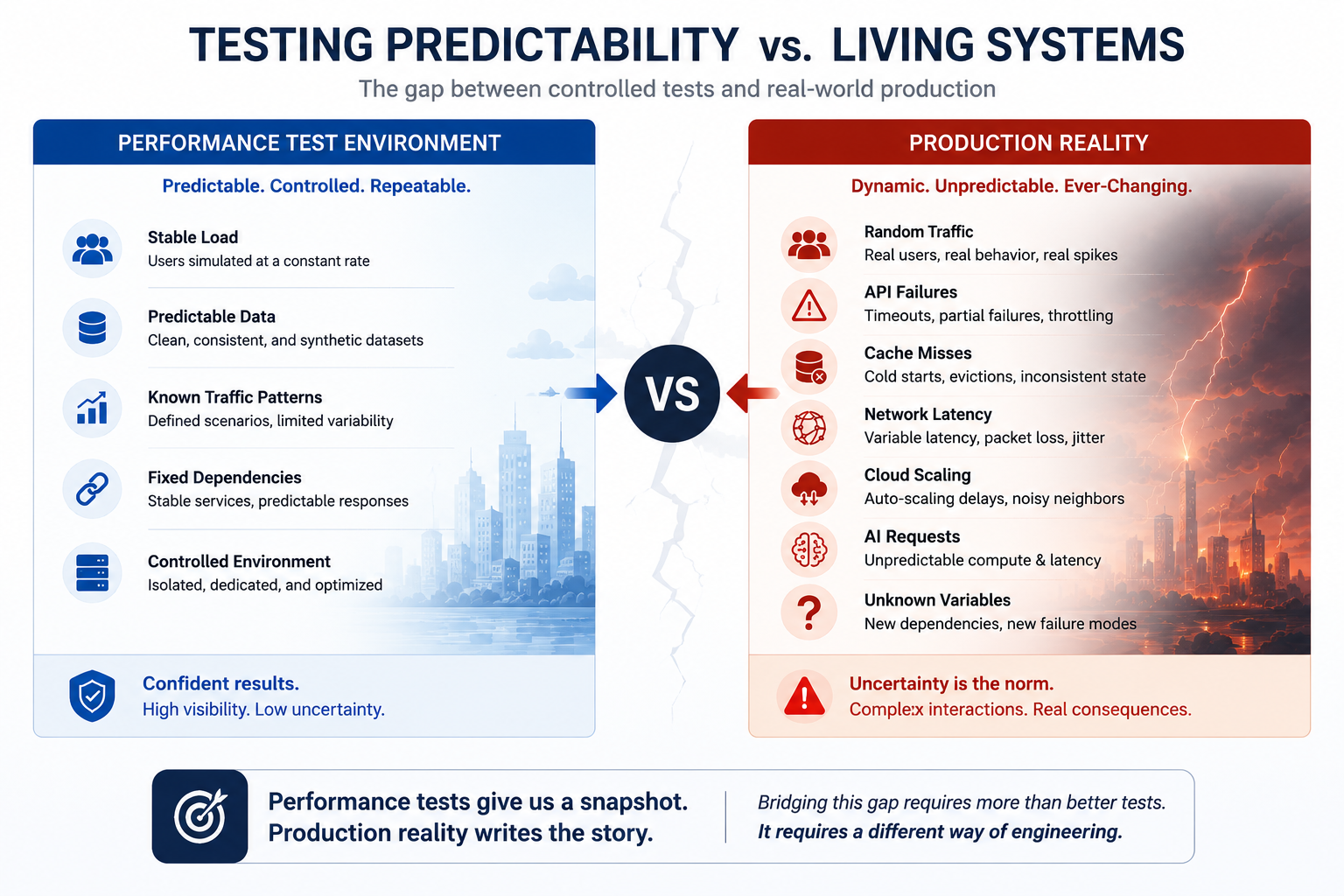
How could systems that had successfully completed performance testing still struggle in production? Why did applications that appeared healthy in controlled environments behave differently once thousands of real customers began interacting with them? Why were engineering teams spending weeks preparing performance test environments while production continued revealing behaviors nobody had anticipated?
These weren't isolated incidents.
They appeared across different organizations, different industries, different technology stacks, and different engineering cultures.
Sometimes a downstream dependency behaved differently under real traffic. Sometimes infrastructure scaled in unexpected ways. Sometimes seemingly insignificant latency accumulated across dozens of service calls until customers began noticing delays. Occasionally, nothing actually failed. Every individual component continued operating exactly as designed, yet the overall system behaved in ways nobody had predicted.
Those experiences gradually changed the questions I was asking.
Early in my career, my instinct was always to improve the testing process. Perhaps our workloads weren't realistic enough. Perhaps our environments were too small. Maybe we needed better tooling, larger datasets, more sophisticated monitoring, or additional automation.
Those improvements certainly mattered.
But over time, I became increasingly convinced they weren't addressing the real problem.
The issue wasn't that our performance testing had failed.
The issue was that we expected performance testing to answer questions it was never designed to answer.
Performance tests can tell us how a system behaves under a defined workload.
They cannot guarantee how that same system will behave after months of architectural evolution, changing customer behavior, new infrastructure patterns, evolving dependencies, and continuous deployments.
Performance testing reveals the consequences of engineering decisions.
It rarely changes those decisions.
That realization became one of the most important lessons of my career.
The most expensive performance problems rarely originate inside performance test reports.
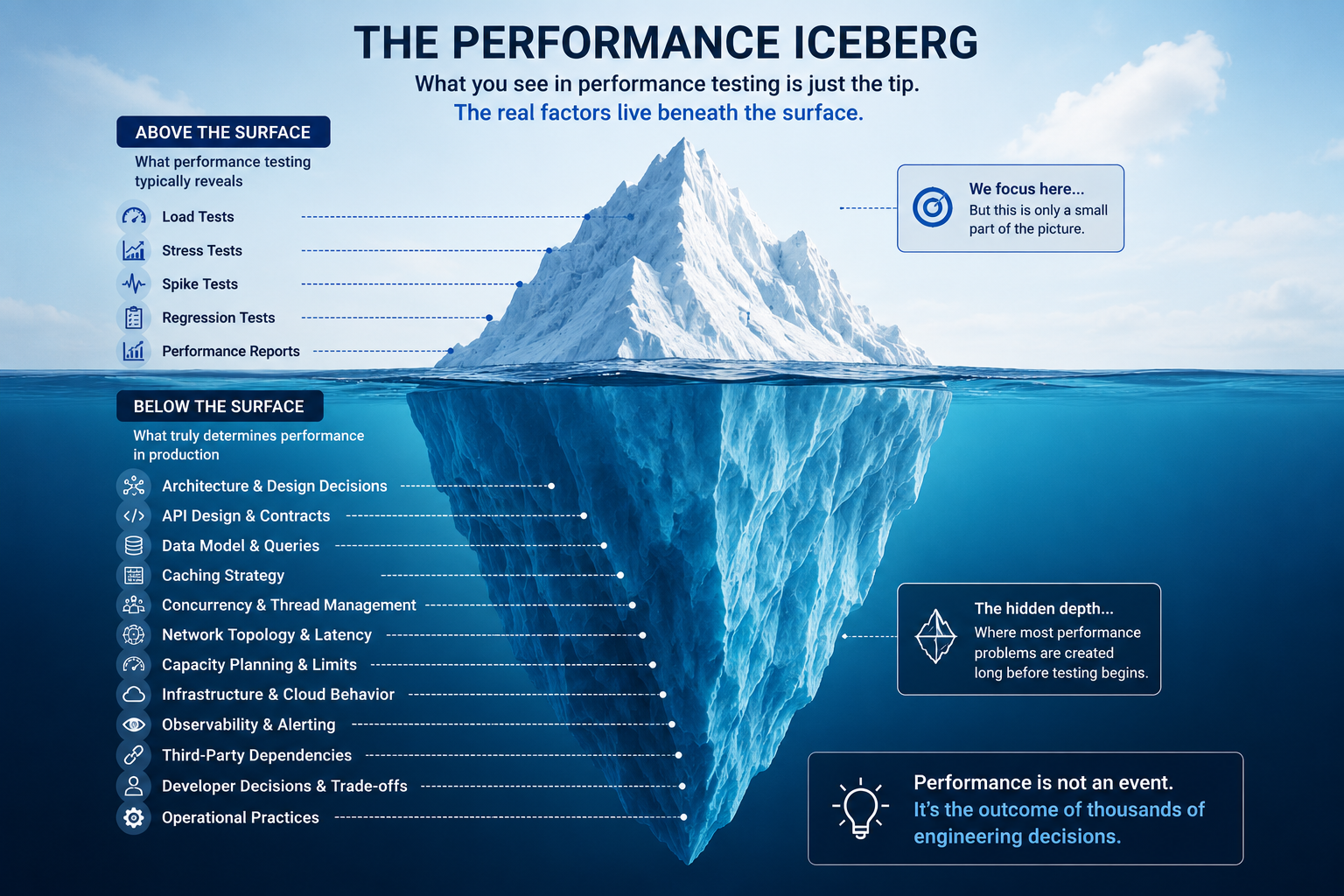
They originate much earlier.
During architecture discussions where scalability receives less attention than feature delivery.
During API design meetings where latency budgets are never defined.
During capacity planning conversations built on optimistic assumptions.
During technology selection where operational complexity is underestimated.
During design reviews where non-functional requirements quietly become someone else's responsibility.
Long before anyone opens a performance testing tool, hundreds of engineering decisions have already shaped how the system will behave under real-world conditions.
Performance testing doesn't create those decisions.
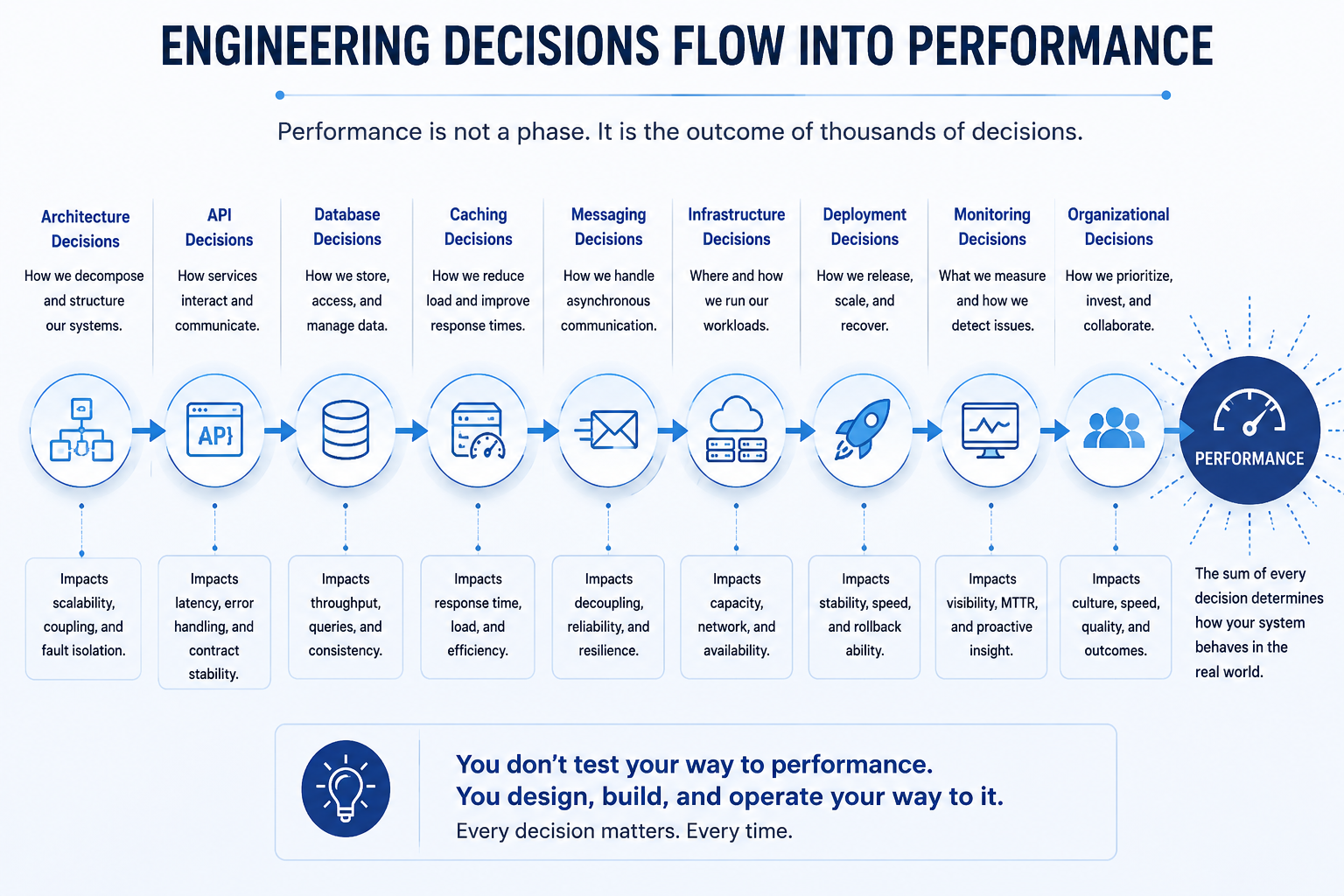
It simply exposes them.
Looking back, I don't believe there was one defining production incident that inspired what eventually became the SCALE Framework.
There were dozens.
Perhaps hundreds.
Every architecture review that prioritized functionality while postponing discussions about scalability.
Every postmortem that traced a production issue back to a design decision made months earlier.
Every engineering team that invested heavily in testing but comparatively little in designing for long-term performance.
Every conversation that reminded me software isn't judged by how well it performs in carefully controlled environments. It's judged by how consistently it performs when customers depend on it.
Over time, those experiences reshaped more than my technical thinking. They influenced how I approached architecture reviews, how I mentored engineers, how I evaluated engineering trade-offs, and how I measured successful software delivery. I gradually stopped viewing performance as a phase owned by specialists near the end of a project. Instead, I began to see it as a responsibility shared by architects, developers, platform engineers, quality engineers, site reliability engineers, and engineering leaders from the very beginning of a system's lifecycle.
That shift in perspective did not happen overnight.
It emerged slowly, shaped by years of building enterprise platforms where reliability, scalability, security, and customer trust were inseparable. It wasn't driven by one breakthrough idea or one remarkable incident. It was the accumulation of countless lessons that, taken together, pointed toward a different way of thinking about software engineering.
Years later, those lessons came together in a simple philosophy that eventually became the SCALE Framework.
But before introducing the framework itself, it's important to understand the challenge it was created to solve. Because the future of performance engineering isn't about running better performance tests.
It's about asking a fundamentally different question.
What if performance isn't something we validate before production?
What if it's something we continuously engineer from the very first design discussion?
That question became the spark behind everything that follows.
That's exactly where we'll begin in the next article.
SCALE Insight
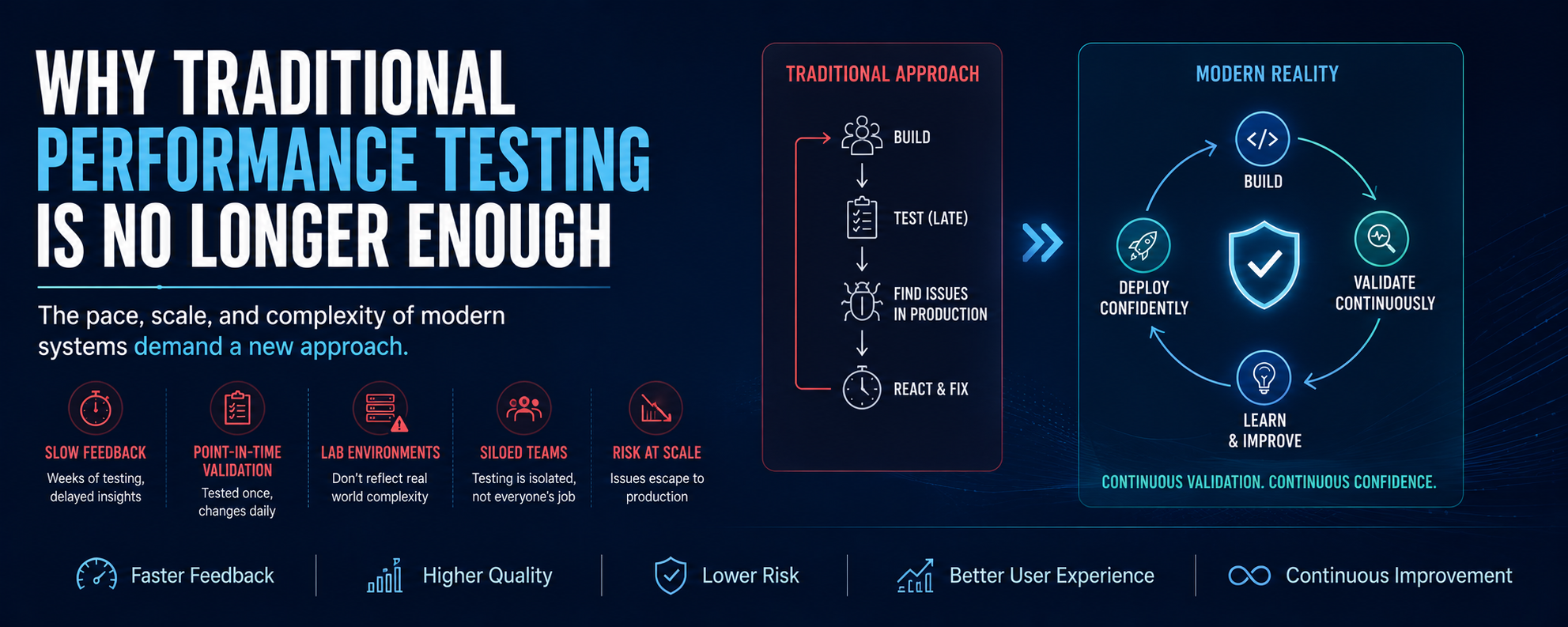
Traditional performance testing remains essential, but it validates software at a moment in time. Modern engineering teams need something broader: a continuous approach that begins with architecture, learns from production, and evolves with every change. That is the shift from Performance Testing to Continuous Performance Engineering.
Next in the SCALE Framework Series
Article 2 – Performance Testing Is No Longer Enough: Understanding the Difference Between Testing Software and Engineering Systems
Comments (0)
No comments yet. Be the first!