 © Ram Brij
The SCALE Framework
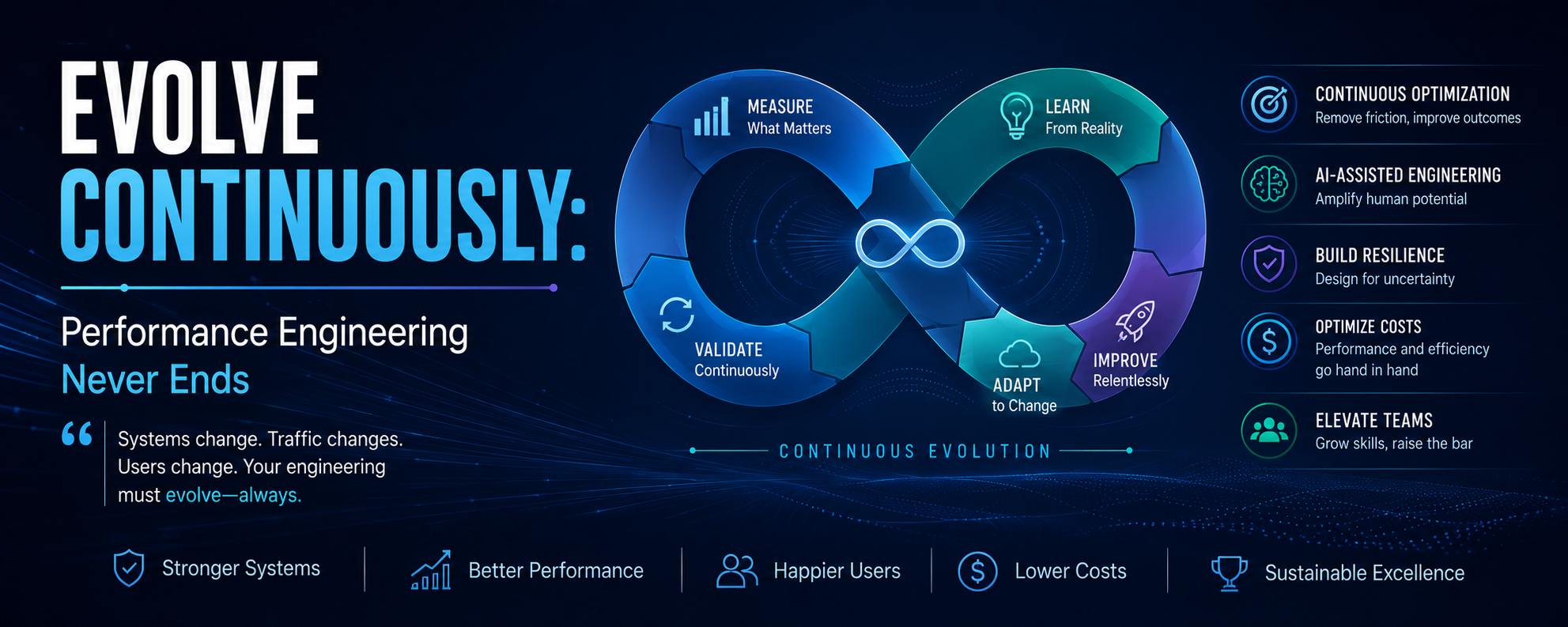
Evolve Continuously: Performance Engineering Never Ends
📘 About this Series
The SCALE Framework Series explores the SCALE Framework, an original methodology for Continuous Performance Engineering developed by Ram Brij through years of enterprise software engineering and technology leadership. Each article builds on the previous one, gradually introducing the framework's philosophy, principles, and practical implementation.
You're reading: Part 8 – Evolve Continuously: Performance Engineering Never Ends
Evolve Continuously
Performance engineering never ends
One of the most persistent misconceptions in software engineering is the belief that a successful system eventually reaches a stable, finished state. Teams modernize an application, migrate it to the cloud, improve the architecture, automate testing, strengthen observability, and optimize performance and once all of that is done, it's tempting to believe the platform has reached maturity, that only routine maintenance is left.
Reality rarely works out that way.
The most successful software systems tend to be the ones that change the most. New customer expectations reshape user journeys. Business priorities shift. Traffic grows in ways nobody predicted. Cloud providers roll out new capabilities. AI changes both how software gets built and how it behaves. Security threats keep evolving, and regulatory expectations keep getting stricter. Even the engineering organization itself changes, as teams grow, reorganize, and pick up new delivery practices.
Under those conditions, architecture is never really static. Performance is never permanently optimized. Reliability is never guaranteed indefinitely. Every improvement just creates a new baseline that the next round of evolution starts from.
This is something I've come back to again and again across years of building enterprise platforms payment ecosystems, cloud-native modernization efforts, high-throughput distributed systems. The pattern that kept showing up: the organizations that consistently shipped reliable, scalable software weren't usually the ones with the best initial architecture. They were the ones that kept refining that architecture as everything around it kept changing.
That's the final principle of the SCALE Framework: Evolve Continuously.
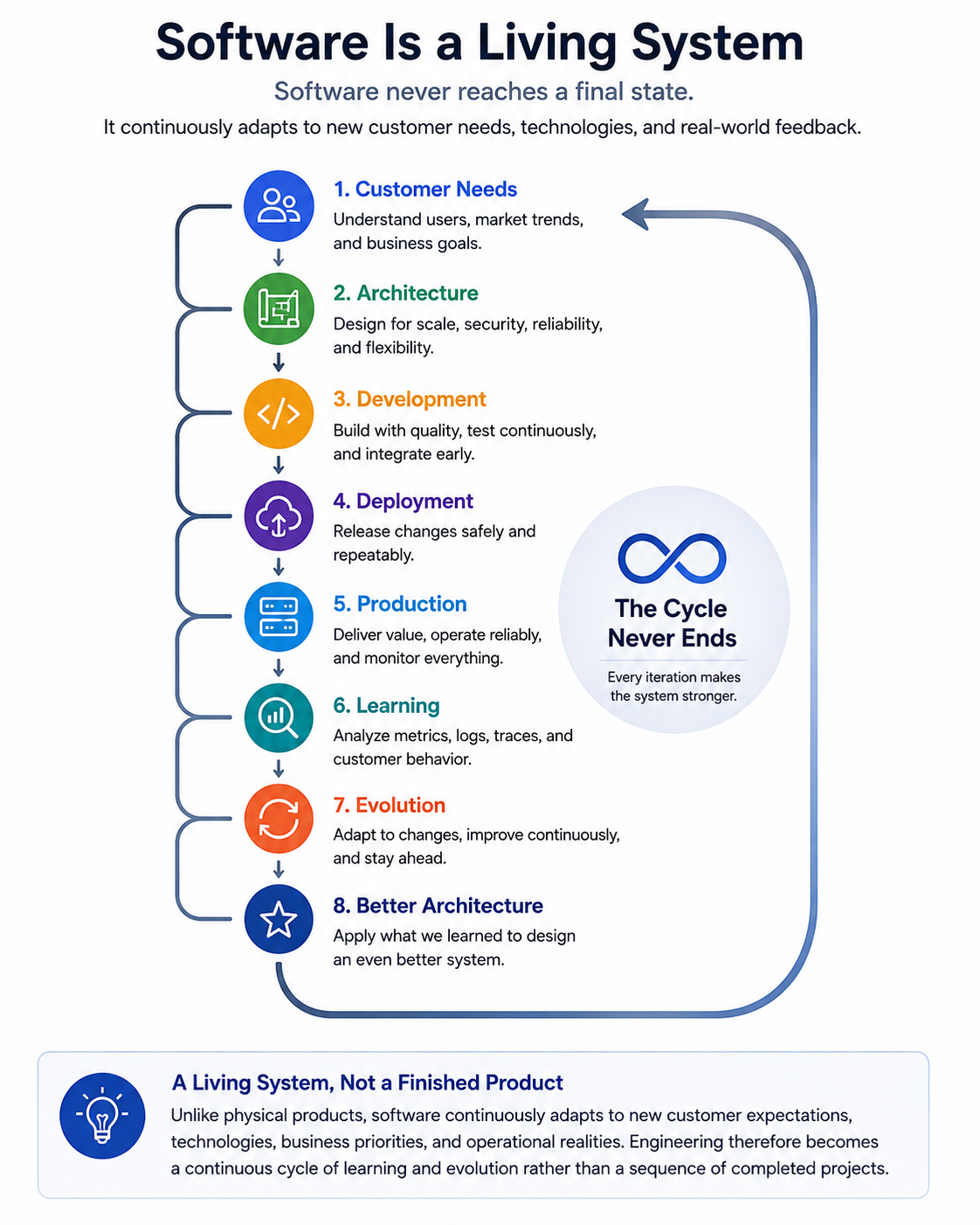
Continuous Performance Engineering was never about designing the perfect architecture or eliminating every bottleneck. It's about building engineering organizations that can adapt faster than the environments their software runs in. Evolution isn't the final stage of engineering it's the condition that makes long-term engineering success possible at all.
Continuous optimization is an engineering habit
Optimization usually gets treated as a project: the team spends a few weeks improving response times, cutting infrastructure cost, or tuning database queries, then moves on to something else. Those efforts deliver real, measurable gains but treating optimization as a destination rather than an ongoing capability rarely holds up for long.
Modern software doesn't stay still long enough for that mindset to work. Every new feature adds complexity. Customer behavior redistributes the workload. Infrastructure changes. Dependencies get upgraded. Small architectural compromises pile up quietly until yesterday's optimizations stop addressing today's constraints.
The organizations that consistently keep high-performing systems handle this differently. They build performance review into regular engineering work instead of scheduling it as an occasional rescue mission capacity trends get looked at during sprint reviews, database performance gets checked after feature releases, infrastructure utilization becomes part of everyday operational planning rather than an annual exercise. Continuous optimization, done this way, is less about reacting to problems and more about catching gradual degradation before customers ever feel it. Performance engineering stops being episodic tuning and becomes an organizational habit, backed by measurement, learning, and disciplined decisions.
AI is changing engineering faster than architecture can keep up
AI is reshaping software engineering at a pace few technologies ever have. Teams increasingly lean on AI-assisted coding, automated code review, intelligent testing, documentation generation, and operational analysis. Applications themselves now build in large language models, recommendation engines, autonomous agents, and retrieval-augmented generation as part of the everyday customer experience.
Those capabilities boost productivity, but they also introduce new variables. AI-generated code can speed up development without guaranteeing architectural consistency. Model behavior can shift independently of any application deployment. A prompt change, a model upgrade, or new training data can alter how an application behaves even when the traditional code hasn't changed at all.
That means engineering practice has to evolve right alongside the technology. Architecture reviews now need to account for inference latency and model dependencies. Performance validation has to extend past application code into the AI workflows sitting inside it. Observability needs to capture prompt execution, token consumption, and model response characteristics right alongside the usual infrastructure metrics.
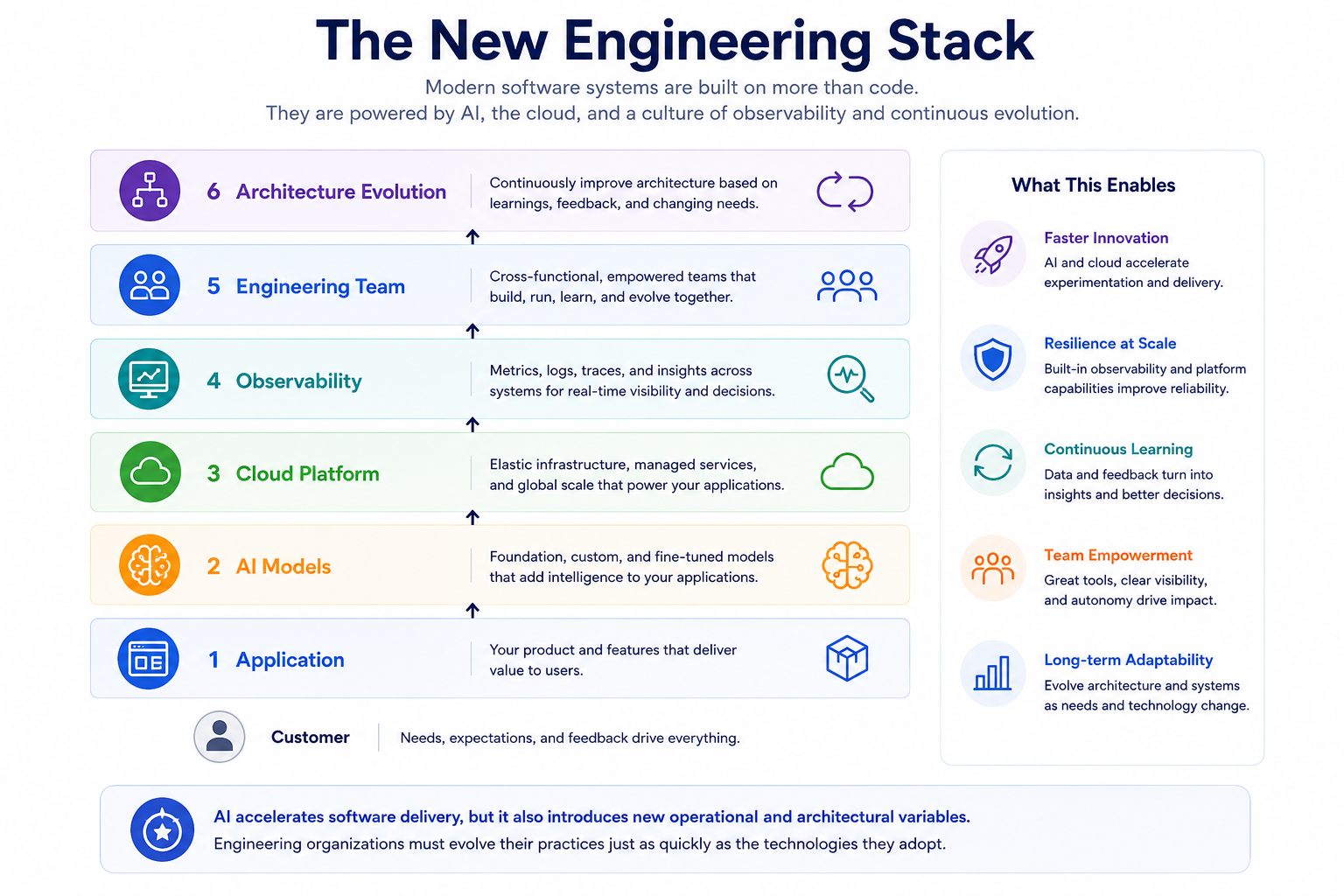
AI doesn't remove the need for disciplined engineering, it raises the bar for it. The organizations that evolve well will be the ones that pair AI-assisted productivity with strong architectural governance, continuous validation, and plain engineering judgment.
Technical debt is deferred engineering
Technical debt gets described as poor code quality or outdated technology, but it's really something broader: engineering decisions that were entirely reasonable when they were made, but have gotten more expensive as the system evolved around them.
Every organization accumulates it. Delivery deadlines, shifting priorities, and incomplete information make it impossible to optimize every decision at the moment you first build something. The real challenge isn't avoiding technical debt altogether, it's keeping it from quietly turning into architectural debt that caps how far the system can scale.
Teams that handle this well keep asking whether yesterday's trade-offs still serve today's goals. Refactoring becomes part of normal delivery instead of a special initiative, and architecture evolves in small increments instead of waiting around for one big modernization project. Technical debt stays manageable exactly when an organization treats evolution as continuous rather than exceptional.
Cloud cost optimization is architecture in disguise
Most organizations only start optimizing cloud cost once the infrastructure bill becomes hard to justify by which point the architecture has already locked in a lot of the available options.
Cost optimization was never really about buying cheaper infrastructure. It's about designing systems that use resources efficiently from the start. Stateless services scale more predictably. Event-driven processing cuts out unnecessary resource use. Good caching avoids repeated computation. Sensible autoscaling policies balance performance against consumption.
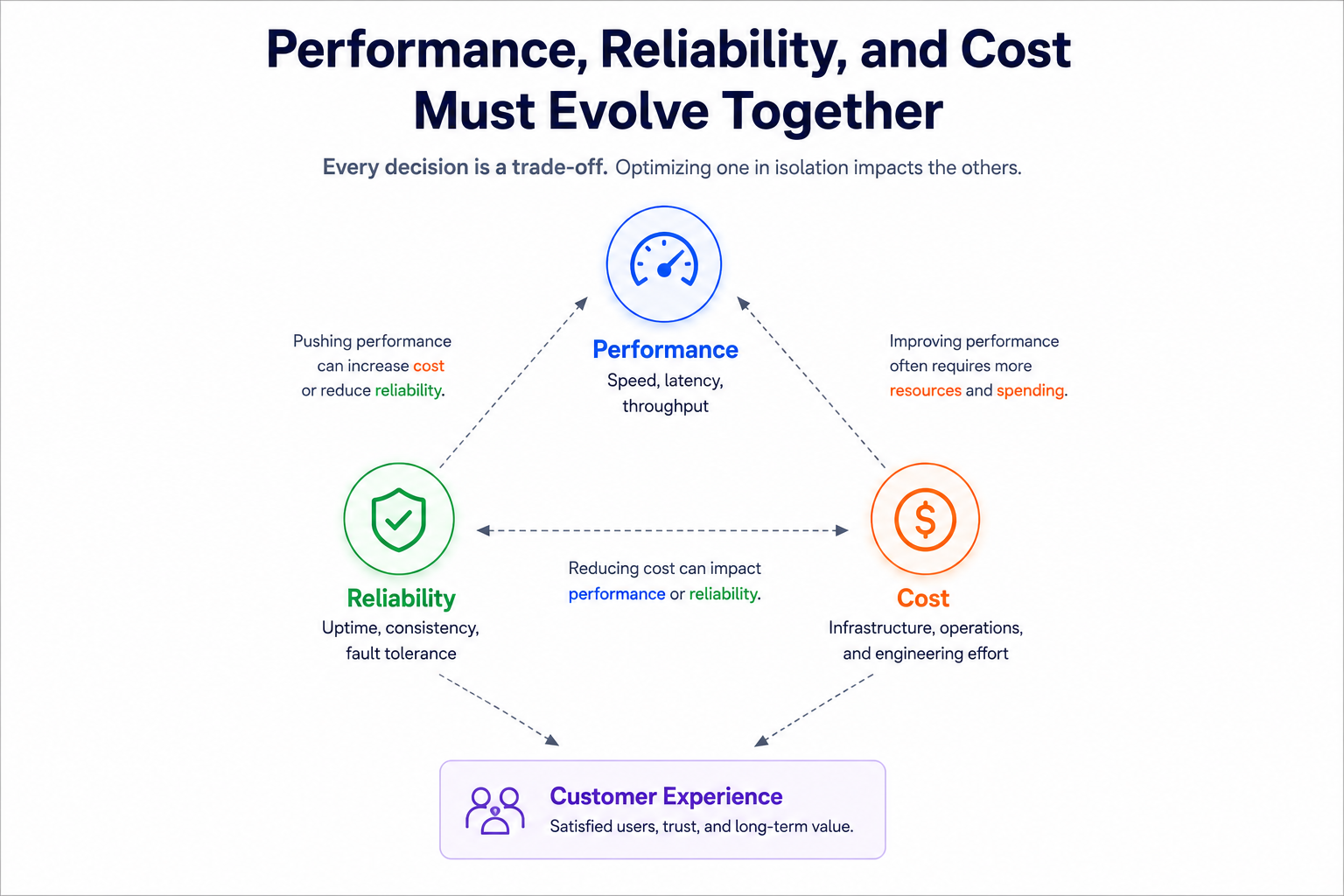
Seen this way, cloud cost becomes another engineering feedback signal. An unexpected cost spike often points to an architectural inefficiency, excessive coupling, or wasted processing worth revisiting in the next design conversation financial efficiency is just another dimension of performance engineering, not a separate operational concern handled by a different team.
Platforms have to evolve before products can
Applications rarely evolve on their own. Their ability to adopt new technology depends heavily on what the engineering platform underneath them actually supports.
CI pipelines, deployment automation, observability tooling, infrastructure-as-code, security controls, developer self-service all of it determines how fast product teams can actually respond when the business needs something new. Organizations that keep investing in platform engineering create an environment where evolution feels routine instead of disruptive. New languages, cloud services, deployment strategies, and AI capabilities can get adopted incrementally, because the platform itself was built with change in mind. Platform evolution is what makes application evolution possible.
Teams evolve before technology does
One lesson that's shaped my leadership thinking more than almost anything else: engineering maturity depends far more on people than on technology.
Architectures get better because engineers keep challenging their own assumptions. Observability becomes valuable because teams actually learn from production instead of just watching it. Continuous validation works because developers, testers, architects, and operations engineers share responsibility for quality instead of handing it off between isolated phases.
As organizations mature, you can hear the shift in the questions engineers ask. Instead of "how fast can we ship this feature," the question becomes "how confidently can we keep evolving this system." That change in the question, more than any specific tool or technology, is what real organizational maturity looks like.
Future-proofing is about adaptability
Engineering leaders ask a lot about how to future-proof a system. The honest answer: no architecture can predict every technology shift, customer expectation, or business opportunity that shows up over the next decade.
Future-proofing was never about building something that never needs to change. It's about building something that stays easy to change. Loose coupling, modular architecture, automated validation, real observability, scalable platforms, and disciplined engineering practice all add up to adaptability. The organizations that thrive over the long run aren't the ones who guessed the future correctly they're the ones who built systems capable of evolving when the future inevitably surprised them anyway.
Bringing the SCALE Framework together
Each principle of SCALE represents a different stage in one continuous cycle of engineering:
Shift Performance Left makes sure performance starts at architecture.
Continuous Validation builds confidence through every change.
Architecture for Scale sets the structural foundation for growth.
Learn Through Observability turns production into ongoing engineering learning.
Evolve Continuously makes sure every lesson turns into an improvement — to the system, the platform, and the organization.
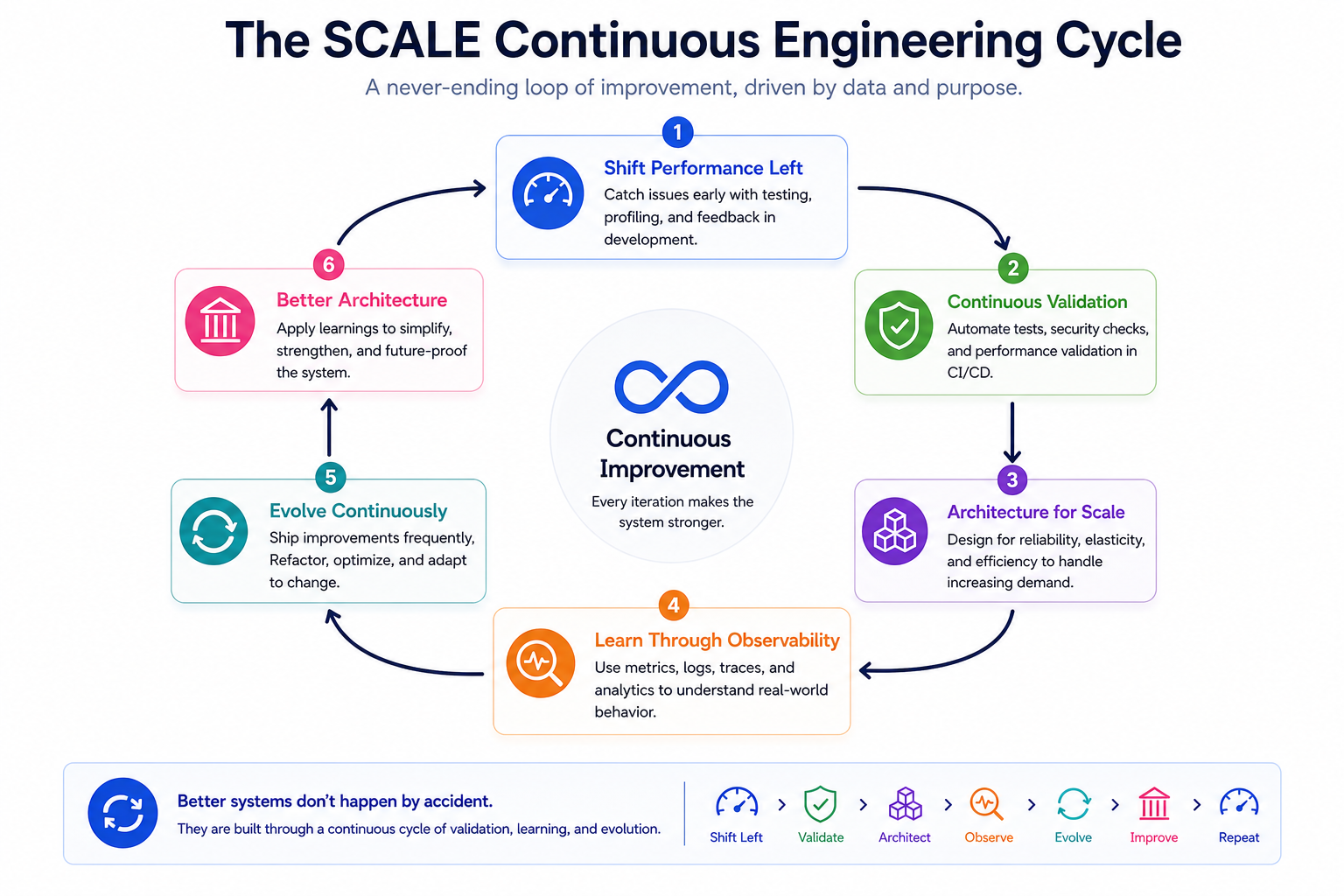
Together, these aren't five separate steps in a line. They're a loop. Performance engineering never really ends, because software itself never stops evolving.
Engineering takeaways
Great software systems continuously adapt to changing environments.
Optimization should be an engineering habit, not an occasional initiative.
AI increases the importance of disciplined engineering rather than replacing it.
Technical debt reflects deferred engineering decisions that need continuous attention.
Cloud cost optimization starts with architectural choices.
Platform evolution enables product evolution.
Engineering maturity depends on learning organizations, not static architectures.
Future-proof systems are designed for adaptability, not permanence.
SCALE Insight
The goal of engineering was never to build software that never changes. The goal is to build software and engineering organizations that get stronger because they keep changing intelligently.
Comments (0)
No comments yet. Be the first!